
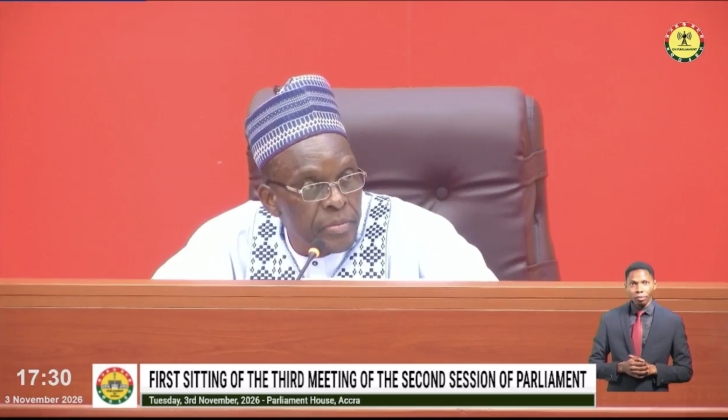
The Speaker of Parliament, Alban Sumana Kingsford Bagbin, has warned that the House will resist attempts to rush legislation through Parliament by routinely suspending its Standing Orders, insisting that Bills must undergo proper scrutiny before passage.
He said the presiding officers Speakers would be particularly reluctant to entertain requests for the suspension of the rules merely to accelerate the passage of legislation, unless the urgency could be clearly demonstrated.
He explained that the growing resort to suspending parliamentary procedures to facilitate the expedited consideration and passage of Bills had become a matter of public concern and required urgent attention.
Addressing the House at the commencement of the Third Meeting of the Second Session of the Ninth Parliament in Accra today (Nov 3), Mr Bagbin said the suspension of Standing Orders, although permissible in exceptional circumstances, must not become the standard procedure for conducting parliamentary business.
“I recognise that there may be exceptional circumstances in which the suspension of particular rules becomes necessary to enable the House to respond to urgent national business. Our Standing Orders themselves contemplate such circumstances.
“However, a procedure intended for exceptional situations must not become the ordinary method by which we conduct our legislative business,” he said.
Legislative scrutiny
The Speaker said the various stages of the legislative process were not mere formalities but safeguards intended to ensure that proposed laws received adequate examination before their passage.
The procedures provided Members of Parliament with sufficient opportunity to examine Bills, identify possible legal and constitutional difficulties and propose necessary corrections, he said.
“The credibility of Parliament as a law-making institution depends not only on our ability to pass legislation but also on the quality, coherence and constitutional soundness of the laws we enact,” he stated.
Mr Bagbin expressed concern that, in some instances, the haste associated with the consideration and passage of legislation had resulted in errors being discovered after the Third Reading of Bills.
Such situations, he said, had sometimes necessitated the rescission of proceedings at that stage to allow corrections to be made.
“While our procedures permit the House, in appropriate circumstances, to revisit decisions already taken, this must not become a substitute for diligent legislative scrutiny,” he said..
He, therefore, urged MPs to resist the temptation to equate legislative efficiency with the speed at which Bills were passed.
Government business
To address the problem, the Speaker urged leadership of House to work closely with ministers and chief executives of state institutions to ensure that government business was presented to the House sufficiently early for proper consideration.
He said ministers and their technical teams must also be available to assist parliamentary committees and the House in examining Bills, addressing concerns and resolving drafting or policy issues that might arise during deliberations.
“Committees must also be afforded reasonable time to undertake their work, including stakeholder consultations. Parliament cannot compromise on the presentation of well-considered reports to the House,” he said.
He disclosed that 11 bills were at various stages of the legislative process, while nine instruments were before committees for consideration.
The House, he said, was also expected to consider 44 papers, 58 motions and 204 outstanding parliamentary questions, in addition to three urgent questions and one petition.
There were also 582 referrals to committees requiring examination, follow-up and timely reporting.
The Speaker consequently urged committee chairpersons and members to expedite work on outstanding referrals and submit their reports within the required timelines.
He said the limited duration of the meeting required MPs to make effective use of parliamentary time without sacrificing the quality of their work.
“Let me emphasise, however, that efficiency must never be pursued at the expense of the quality of our work.
“The effectiveness of Parliament is not measured merely by the number of items disposed of, but by the diligence, thoroughness and integrity with which we discharge our constitutional responsibilities,” he advised.
