
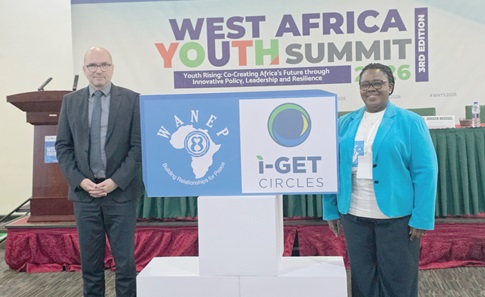
The Executive Director for the West Africa Network for Peacebuilding (WANEP), Levinia Addae-Mensah, has called for greater youth representation in political decision-making in the sub-region.
This, she said, would strengthen democratic governance, deepen peacebuilding efforts and enable young people to co-create sustainable solutions to West Africa's development challenges.
Mrs Addae-Mensah made the call at the third West Africa Youth Summit organised by WANEP under its Youth, Peace and Security Programme in Accra yesterday.
"Democratic institutions become stronger when young people participate meaningfully in governance,” she said.
Summit
The two-day summit brought together young leaders, policymakers, diplomats and development partners from across the sub-region on the theme, "Youth Rising: Co-Creating Africa's Future Through Innovative Policy, Leadership and Resilience."
It sought to advance youth leadership, promote intergenerational dialogue and encourage innovative approaches to peacebuilding, governance and sustainable development.
The summit also saw the launch of the Intergenerational Empowerment and Transition (IGET) Circle, a structured mentoring mechanism designed to enhance cooperation, knowledge transfer, networking, and strategic thinking between the older and younger generations.
It seeks to actively connect young leaders with high-level decision-makers: diplomats, entrepreneurs, security experts, academics and innovators.
Trust
In her address at the summit, Mrs Addae-Mensah urged governments and organisations to trust young people with greater responsibility instead of limiting them to consultative roles.
She argued that many young people had already demonstrated resilience through entrepreneurship, peacebuilding, innovation and community service despite economic hardship and shrinking opportunities.
"The problem has never been your readiness.
The problem has been the unwillingness of the system and leaders to make space for what you bring," she said.
The executive director also encouraged young people to continue building coalitions, questioning constructively, innovating boldly and holding governments accountable through peaceful civic engagement.
She also challenged political leaders to replace token participation with genuine partnerships by sharing leadership and creating space for young people to shape policies alongside older generations.
For his part, the Austrian Ambassador to Ghana, Jürgen Heissel, also encouraged governments, civil societies and the private sector to invest in young people.
He also called for stakeholder collaboration to harness digital innovation and artificial intelligence for education, entrepreneurship and civic participation while ensuring inclusive access.
“I urge governments and political leaders to create opportunities for young people to influence public policy and assume leadership roles effectively,” he said.
Mr Heissel added that Austria supported the summit because lasting peace depended on involving young people directly in decision-making rather than designing policies on their behalf.
"Sustainable peace cannot be built for young people; it must be built with young people. Leadership begins today. It begins with the courage to engage, to listen, to innovate, and to serve our community," he said.
The ambassador also welcomed the summit's emphasis on structured intergenerational dialogue, institutional inclusion and practical mechanisms that enable young people to influence public policy.
He said those priorities aligned with Austria's commitment to democracy, human rights and international cooperation.
