
The creation of more districts does not necessarily guarantee improved service delivery or economic development, a local government expert, Eric Oduro Osae, has said.
He said the expansion of Ghana’s local government system must be guided by evidence, economic viability and the capacity of assemblies to function effectively.
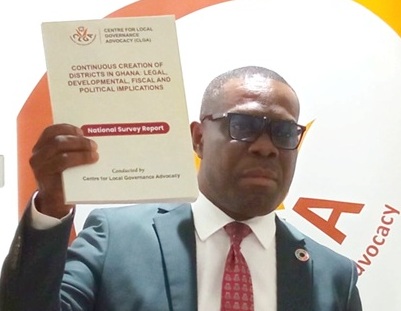
Mr Oduro Osae was speaking at the media launch of a survey report by the Centre for Local Governance Advocacy (CLGA) in Accra last Tuesday.
He said Ghana had increased its number of districts from 110 in 1980 to 261, raising questions about whether the expansion had delivered the intended developmental benefits.
“More districts do not necessarily mean better services or stronger economies. We must be able to demonstrate the developmental benefits of creating these assemblies,” he said.
Mr Oduro Osae, who is also the Chief Executive Officer of the Institute of Chartered Accountants, Ghana (ICAG), said although decentralisation was a constitutional requirement intended to promote citizen participation, accountability and development, the creation of new assemblies must be justified by their developmental benefits.
Population threshold
He said the law required a district to have a minimum population of 75,000, geographical continuity and economic viability.
However, data from the 2021 Population and Housing Census showed that about 70 of the country’s 261 Metropolitan, Municipal and District Assemblies (MMDAs) had populations below the statutory threshold.
He cited disparities in population sizes, with one assembly having about 28,000 residents, while another had more than 400,000, exceeding the 250,000 population threshold for reclassification.
Mr Oduro Osae questioned whether the requirements for creating new districts were being consistently applied or influenced by political considerations.
He said new assemblies came with significant financial obligations, including administrative offices, security infrastructure, health facilities and other essential services.
He noted that some newly created assemblies struggled to generate enough internally generated funds to support their operations and consequently depended heavily on the District Assemblies Common Fund.
He, therefore, called for greater investment in existing assemblies through adequate staffing, infrastructure, resources and the decentralisation of powers. He also stressed the need for statutory requirements to be applied consistently, irrespective of the political party in power.
The Deputy Executive Director of the CLGA, Gladys Gillian Naadu Tetteh, said the survey sought to establish whether the creation of additional districts had improved local governance and service delivery.
She said the research covered 104 of the country’s 261 districts, comprising old and newly created assemblies, and sought citizens’ views on the effectiveness of the existing district administration model.
Mrs Tetteh disclosed that 81 per cent of respondents believed political considerations had outweighed the stated objective of bringing governance closer to the people.
She said inadequate staffing and infrastructure deficits were among the major challenges confronting newly created assemblies.
Policy action
The CLGA called on the government, Parliament, the Electoral Commission and civil society organisations to collaborate in developing a clear policy framework to guide the creation and management of districts.
It urged policymakers to base future decisions on population requirements, geographical considerations, financial sustainability and the ability of assemblies to provide essential services.
The Centre also urged the media to interrogate the findings and hold policymakers accountable, while encouraging voters to consider the issue when assessing political parties’ manifestos ahead of the 2028 general election.
It said the report would be submitted to the appropriate authorities for consideration and policy action.
