
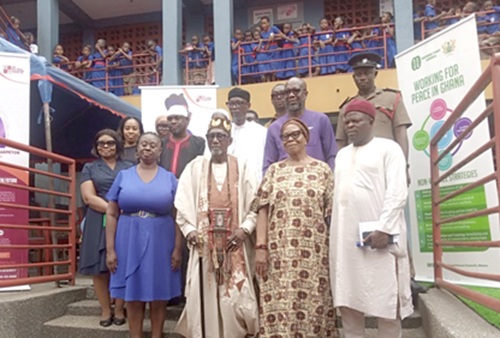
The National Peace Council (NPC) has said diversities in religious beliefs, ethnic backgrounds, cultures and opinions should not be a source of division among the citizenry of the country.
Rather, it said they should be opportunities for mutual understanding and respect.
It has, therefore, charged students to respect religious and cultural diversity, embrace tolerance and resolve disagreements through dialogue to promote peaceful coexistence in schools and communities.
The Director of Capacity Development and Outreach at the NPC, Janet Sarney-Kuma, gave the advice at a peace education forum organised by the Rev. Emile Doe Dogbe Gakpetor Foundation in collaboration with the council in Accra last Tuesday.
The programme was aimed at educating students on conflict prevention, religious tolerance and peaceful coexistence.
Ms Sarney-Kuma said peace did not happen automatically but required conscious efforts by individuals and communities to sustain it.
She urged the students to respect the religious practices and symbols of their colleagues, avoid hate speech and discrimination, and make efforts to understand the beliefs of people from different religious backgrounds.
She also encouraged them to settle misunderstandings through dialogue and other non-violent means rather than resorting to physical confrontations.
Ms Sarney-Kuma said young people had an important role to play in maintaining national peace and urged them to channel their energies into productive activities.
Tolerance
The Headmistress of Mount Zion Basic School, Ophelia Zungbey, also called for greater religious tolerance, mutual understanding and acceptance among people of different faiths.
She said religious and cultural differences should not be regarded as threats but celebrated as elements that enrich communities.
Mrs Zungbey stressed the need for people to move beyond merely tolerating one another to embracing genuine acceptance and understanding.
The Mount Zion Basic School Headmistress said the programme provided an opportunity for participants to share experiences, deepen their understanding of religious diversity and identify practical ways of building bridges across communities.
She noted that peacebuilding was not the sole responsibility of government institutions but a collective duty that must begin in communities, schools, markets and homes.
“Peacebuilding doesn't start in the halls or houses or offices of government. It starts right here, in our neighbourhoods, in our schools, in our markets,” she said.
Mrs Zungbey urged the participants to make meaningful contributions towards promoting unity and understanding, stressing that peaceful coexistence required commitment and collective action.
For his part, a spokesperson for the National Chief Imam, Sheikh Aremeyaw, urged pupils to embrace peace, love and religious tolerance to strengthen national unity and prevent violence.
He said Muslims, Christians and traditional believers shared common values of peaceful coexistence, mutual respect and love, which must be nurtured from childhood.
