
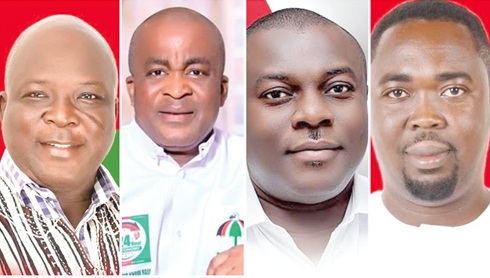
When the governing National Democratic Congress (NDC) goes to the polls on Saturday and Sunday at the regional level across the country, delegates will be electing a key component of delegates for the next national executive positions.
Whether imaginary or real, alliances and allegiances will shape the power struggle in a major test of the party’s organisational strength and internal cohesion for the future.
Beyond the election of regional officers, the polls carry significant implications for the party's grassroots mobilisation, internal power balance and preparations for the next national executive elections scheduled for December 19.
The positions being contested include regional chairman, vice-chairman, secretary, deputy secretary, treasurer, organiser, communications officer, zongo caucus coordinator, women's organiser and youth organiser, as well as their respective deputy positions.
The elected executive will be responsible for coordinating party activities, strengthening constituency structures, resolving internal disagreements and mobilising supporters to improve the NDC's electoral fortunes.
Preparations for the polls
The Spokesperson for the Congress Elections Committee, Dr Peter Boamah Otokunor, told the Daily Graphic that all was set for the regional executive elections.
The party's Director of Elections and IT, Mahdi Jibril, cautioned aspirants against using money and other material inducements to influence delegates, saying the party was determined to prevent the practice, particularly on election day.
Mr Jibril added that the party was engaging the Ghana Police Service to finalise security arrangements, while the Electoral Commission was preparing the ballot papers.
He also said measures were being put in place to ensure the peaceful conduct of the regional elections.
The Regional Youth and Women’s Conference will precede the regional polls on Friday, November 13.
Key battlegrounds
Several regional chairmanship contests have emerged as major battlegrounds, with incumbents facing challenges from party stalwarts seeking changes in leadership.
In the Upper East Region, incumbent Chairman, Alhaji Abdulai Mumuni Bolnaba, faces a fresh challenge to his more than two-decade leadership as he seeks a fifth term, with educationist Duncan Nsoh Ghaneba emerging as his challenger.
In Greater Accra, incumbent Chairman Emmanuel Nii Ashie Moore is seeking re-election against challengers, including Michael Tetteh Kwetey and Benjamin Danso.
Mr Moore, who unseated Joseph Ade Coker in 2022, faces criticism from sections of the party over his leadership record.
Kwetey, who has received the endorsement of the Ningo-Prampram executive, is among those seeking to unseat the incumbent.
In Ashanti, the incumbent Chairman, Andrews Augustus Nana Kwesi, is seeking a third term against the outgoing Regional Organiser, Isham Alhassan Yaw Bonsu.
The contest pits an incumbent seeking continuity against a challenger with considerable grassroots experience, having served at the ward, constituency and regional levels since 1992.
Other contests
In the Bono Region, incumbent Chairman, Kwadwo Nyamekye Marfo, faces Justice Samuel Adjei.
The Western Regional Chairman, Nana Kojo Toku, is seeking to retain his position against two challengers, including former Regional Vice-Chairman, Samuel K. Borlu.
In the Central Region, three aspirants, including lawyer Charles Obeng Inkoom, who has made rebuilding the party's fortunes a central campaign message, are contesting the chairmanship.
For the Eastern Region, Dr Mark-Oliver Kevor is also seeking re-election as chairman following his resignation as Director-General of the National Information Technology Agency.
Dr Kevor has two contenders, a former Eastern Regional Chairman, Bismark Tawiah Boateng, and a party stalwart in the region, David Dakudzi.
In the Northern Region, three party stalwarts will slug it out for the chairmanship.
They are a former Regional Organiser and a third-time Regional Chairman contestant, Godfred Apasinaba Sulemana Wumbie; businessman Alhaji Tanko Maida, and the incumbent Northern Regional First Vice-Chairman, Alhassan Abdul Hamid, popularly known as Chairman Gbewaa.
In the Upper West Region, incumbent Chairman, Abdul Nasir Saani, faces Nadowli-Kaleo Constituency Chairman, Sombawiere Samba, popularly known as Sankara, and businessman Alhassan Aadam Randy.
December calculations
Although the chairmanship contests are attracting considerable attention, the regional secretary position is equally an interesting fixture because of the influence of the regional secretaries in the administration, coordination and implementation of party decisions.
The outcome of the regional elections could also influence the December 19 national executive elections, as successful regional chairmen and their teams could command considerable influence through their grassroots networks and relationships with delegates.
The polls follow the party's constituency-level elections across 276 constituencies and represent another significant stage in its organisational restructuring.
The 2028 test
Ultimately, the significance of the elections will be measured by the ability of the new regional executive to unite the party, defend its electoral strongholds, resolve internal disagreements and make inroads into areas where it faces stiff competition.
For a governing party seeking to consolidate its political position, the challenge will be to ensure that competition for internal leadership does not weaken its organisational cohesion.
With the December national executive elections following closely, the November 14 and 15 regional polls could provide an early indication of the balance of power within the NDC and the political forces likely to shape its preparations for 2028.
