
The Speaker of Parliament, Alban Sumana Kingsford Bagbin, has dismissed a Private Member’s motion seeking parliamentary inquiry into a series of reported narcotics seizures linked to Ghana in recent times.
He ruled that the motion was inadmissible because its proposed inquiry substantially overlapped with ongoing investigations and criminal proceedings before the courts, creating a risk of prejudicing the interests of parties involved.
Acknowledging that the matter fell within his jurisdiction as Speaker, he said he had carefully considered the motion, its proposed terms of reference, the investigations already underway and the pending court proceedings before arriving at his decision.
Prejudicing court process
Giving his ruling during an emergency sitting of the House yesterday, Mr Bagbin said the proposed parliamentary inquiry could require Parliament to determine issues that properly fell within the remit of the courts.
“The combined effects of undertaking this evaluation, assessment and investigation would be, at the end of the day, to determine the very issues that the court of competent jurisdiction is supposed to determine,” he said.
“Accordingly, I am of the considered opinion that permitting the motion to proceed in its present form as presented by a Leader of the House at this particular time may prejudice the interests of parties to pending judicial proceedings. I, therefore rule, pursuant to Standing Orders 5, 6, and 103 (f), that the private member's motion is inadmissible,” he ruled.
The ruling followed a petition by the Minority Caucus for the House to be recalled to consider what it described as matters of urgent national importance.
The petition was triggered by the seizure by French authorities of nearly 3.9 tonnes of cocaine at the Port of Dunkirk from a container reportedly originating from Ghana.
The Minority subsequently filed a Private Member’s motion seeking the establishment of an ad hoc committee to investigate the circumstances surrounding the shipment and other major narcotics seizures linked to Ghana.
Parliament not barred
Mr Bagbin, however, stressed that his ruling did not prevent Parliament from exercising its constitutional oversight responsibilities over narcotics trafficking, port security, border controls or the performance of state institutions.
“This is a procedural determination.
It is not a determination of the underlying allegations,” he said.
He explained that the Minority had met the constitutional requirement for an extraordinary sitting, with the members who petitioned him representing more than the 15 per cent threshold required under Article 112(3) of the 1992 Constitution.
The Speaker, however, stressed that summoning Parliament did not automatically mean that the substantive matter in the petition had been approved for debate.
According to him, any member seeking a substantive decision of the House was required to comply with the procedures prescribed by the Constitution and the Standing Orders.
Scope of motion
The motion, filed on Monday, September 28, by the First Deputy Minority Whip and Member of Parliament for Tolon, Habib Iddrisu, under Standing Order 102, sought the establishment of a committee under Article 103 of the Constitution and Order 262 of the Standing Orders.
The proposed committee was expected to conduct what the sponsor described as a “total, transparent and full-scale bipartisan enquiry” into major narcotics seizures linked to Ghana.
Pending cases
Mr Bagbin cited Standing Order 103(f), which provides that a motion shall not be the subject matter of an action on which a judicial decision is pending where, in the Speaker’s opinion, consideration of the matter may prejudice the interests of parties to the action.
He said national investigative and law-enforcement bodies had already commenced investigations into the reported narcotics seizures and that some of those processes had progressed into criminal proceedings before courts of competent jurisdiction.
He said official searches available to him indicated that four substantive narcotics-related cases connected to the matters covered by the proposed inquiry were pending before the courts, involving about 21 persons standing trial.
Risk of prejudice
The Speaker said a parliamentary committee could be required to hear evidence and witnesses on factual matters that could simultaneously arise in the pending criminal proceedings.
“There is, therefore, substantial overlap between the proposed parliamentary fact-finding exercise and matters presently engaging investigative bodies and the courts,” he said.
“That raises precisely the concern contemplated by Standing Order 103 (f),” he added.
Mr Bagbin referred to previous parliamentary discussions on the relationship between parliamentary proceedings and pending judicial cases, saying the sub judice rule did not automatically prohibit Parliament from considering matters connected to litigation.
He said the critical consideration was whether parliamentary proceedings created a sufficient risk of prejudice to parties involved in pending judicial proceedings.
Minority disagrees
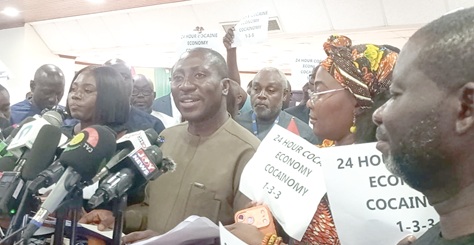
The Minority Leader, Alexander Afenyo-Markin, however, stated that the Speaker got it all wrong in dismissing the Private Member’s Motion seeking parliamentary inquiry into a series of narcotics seizures linked to Ghana.
He said the ruling by Mr Bagbin improperly curtailed Parliament’s constitutional oversight powers.
In his view, the Speaker erred in relying on pending court cases to prevent Parliament from investigating the administration and effectiveness of public institutions connected to the narcotics incidents.
Weakening Parliament
Addressing the press after the Speaker’s ruling during an emergency sitting, Mr Afenyo-Markin described the development as “a sad day for democracy and parliamentary oversight” and accused the Majority Caucus of using its numbers, with the support of the Speaker, to weaken Parliament.
“Mr Speaker tells us that there are certain matters before the court but he does not explain to us how these matters oust the constitutional jurisdiction of Parliament to enquire into the conduct, administration and effectiveness of public institutions involved in the matter.
“The Majority are resisting scrutiny and they quickly welcomed the Speaker’s decision and moved to adjourn the sitting,” he said.
Oversight role
The Minority Leader said the Minority-sponsored motion did not seek to interfere with criminal proceedings or determine the guilt or innocence of accused persons but rather to examine whether state institutions had effectively discharged their responsibilities.
He said Articles 93(2) and 103 of the 1992 Constitution vested legislative and oversight powers in Parliament, with Article 103(3) expressly empowering parliamentary committees to investigate and enquire into the activities and administration of ministries, departments and agencies.
He further cited Article 103(6), which gave parliamentary committees the powers, rights and privileges of the High Court for purposes including compelling witnesses to attend, examining them and requiring the production of documents.
“These provisions, we submit, are important because the motion we filed before the House does not seek to try any accused person”.
“It does not ask Parliament to determine criminal liability, pronounce upon the guilt or innocence of any person, assess the credibility of prosecution witnesses or decide upon evidence that is properly before a court.
The import of our motion is institutional oversight,” Mr Afenyo-Markin said.
