
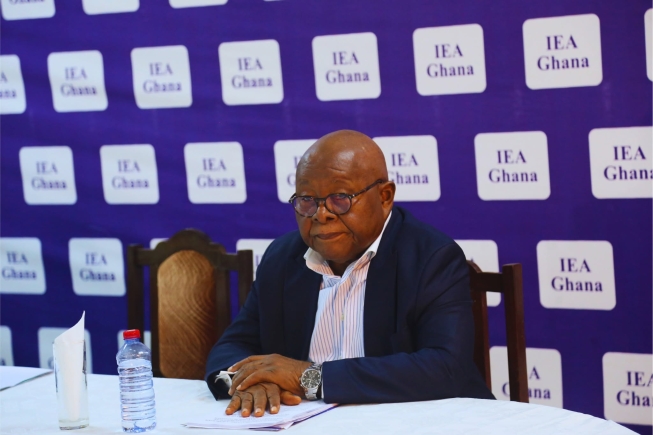
Former Speaker of Parliament, Professor Aaron Mike Oquaye, has called for constitutional reforms to make some key public institutions more independent of presidential control to promote continuity in national development.
He said institutions whose responsibilities require technical expertise should have the authority to appoint their own representatives rather than depend on presidential appointments.
Such proposed changes, he said, would help prevent successive governments from abandoning development initiatives started by their predecessors.
“In this country, it looks as if every four years we act as if we are starting to build the country again and that attempt to rebuild the nation makes us go backwards rather than moving forward,” he said.
He was speaking at a forum on the Prempeh Committee’s report and the government’s position on constitutional review organised by the Institute of Economic Affairs (IEA) in Accra last Tuesday
Independent development planning
For instance, Prof. Oquaye said the National Development Planning Commission (NDPC) could only become effective if its membership and decisions were protected from presidential control.
He said the members should also elect their own chairperson to protect the commission’s independence and enable it to make decisions based on technical expertise and national priorities.
He argued that an independent commission would strengthen long-term planning and help address abandoned projects and the disruption of development programmes whenever political power changed hands.
Citing Singapore as an example, Prof. Oquaye said Ghana needed to give technocratic expertise a stronger role in public administration and national development.
Lands Commission independence
The former Speaker also called for constitutional provisions to strengthen the independence of the Lands Commission and safeguard the rights of citizens over land and other natural resources.
He said constitutional reform should examine not only who held trusteeship over land but also the composition, powers and independence of the institutions responsible for managing land.
Prof. Oquaye said the Constitution should clearly protect matters relating to minerals, land and other national resources rather than leave essential safeguards to subsequent legislation.
Natural resource transparency
A former Deputy Minister of Lands and Natural Resources, George Mireku Duker also proposed that the constitutional framework should expressly recognise transparency in resource allocation, accountability for decisions and revenues, sustainable development, environmental protection, equity among communities and generations, and public participation in decisions affecting natural resources.
He said transparency should extend beyond publishing mining agreements after key decisions had already been made.
“The public should be able to know who ultimately owns companies holding major concessions, what the agreements require, what revenue Ghana is entitled to receive, what tax exemptions have been granted, how much mineral production takes place, and whether companies are meeting their environmental and rehabilitation obligations,” he said.
Mr Duker said Parliament needed access to reliable expert information to determine whether agreements offered fair returns to the country and adequately protected the public interest.
He proposed clear timelines for parliamentary decisions on resource agreements, arguing that delays in ratification could leave concessions unresolved and undermine accountability.
Benefits for mining communities
Mr Duker said constitutional reforms should ensure that communities affected by mining received a fair share of the benefits from natural resource extraction.
He noted that although mining generated foreign exchange, taxes, royalties and employment, host communities often faced damaged roads, polluted water, loss of farmland, displacement and declining livelihoods.
