
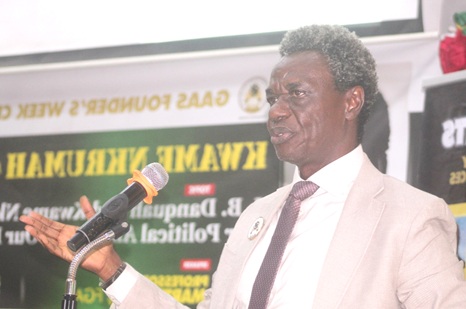
A professor of philosophy at the Department of Philosophy and Classics at the University of Ghana, Legon, Professor Martin Odei Ajei, has urged political actors to focus on the convergence ideologies of Ghana's first president, Dr Kwame Nkrumah, and his political opponent, J. B. Danquah, to shape the country's political future rather than dwell on their differences.
He their political, ideological and philosophical differences did not mean they were enemies.
Prof. Ajei was delivering a lecture at the Kwame Nkrumah Memorial Lecture dubbed "The Founder's Week celebration" by the Ghana Academy of Arts and Sciences in Accra last Friday.
It was on the topic "J. B. Danquah and Kwame Nkrumah: Our political ancestors, our political future".
The yearly week-long celebration, which began in 1960 but was re-introduced in 2003 to celebrate the academy's first black president, Dr Nkrumah, attracted people from academia, including Prof. Peter Quartey, Prof. Nana S. K. B . Asante, students, mainly from the philosophy department and family members of the lecturer.
The anniversary firmly focused on important national topical issues that were meant to shape the country's political future.
Differences
Tackling the topic, the professor of philosophy noted that there were political, ideological differences between the two "political ancestors" but insisted that their differences had been unnecessarily exaggerated, playing down where their ideas converged, which had helped redefine Ghana's political landscape.
"Anyone with a slight interest in Ghanaian history comes away believing Danquah and Nkrumah were fierce antagonists.
"And since the 1966 coup d'etat (that overthrew Nkrumah) and more so since the fourth republic began in January 1993, the rivalry has hardened into Nkrumah versus Danquah-Busia-Dombo traditions," Prof Ajei alluded.
He said in name, but not in practice, the two traditions were presented as opposed.
The philosopher said that the creation of a supposed difference was as a result of the socialist or statist ideology of Nkrumah as against the liberal, capitalist or free-market ideology of Danquah.
Historical, philosophical
Prof. Ajei said, however, that the portrayal of their philosophies as mutually exclusive may be philosophically overstated and politically overextended.
He posited that the post-1966 political identity exaggerated their differences and turned a historically contingent rivalry into an enduring ideological cleavage.
Imperative/normative
He said rather than duelling on what divided them, it was important to note that the two ancestors shared a substantial normative standpoint.
And these convergences ground shared principles of legitimate political organisation, which could help evaluate proposals in the current constitutional amendment process.
About the academy
The Ghana Academy of Arts and Sciences is Ghana's premier learned society.
It was founded in November,1959, by government instrument of incorporation.
It aimed to bring together the highest level of intellectuals, experts and professionals in the country to constitute a "think tank" in the arts and sciences to enable it to advise government and other relevant bodies on issues of importance to national development.
