
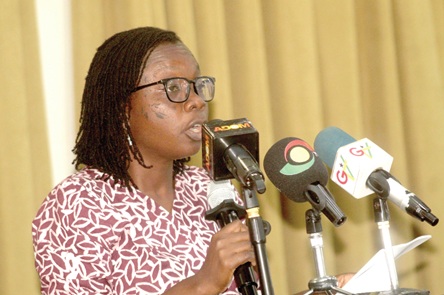
The Civil Society Organisation Platform on Constitutional Reforms has urged the Constitution Review Implementation Committee (CRIC) to involve citizens in the review process.
"They must be informed.
They must be consulted.
They must be given a genuine opportunity to express their views.
"Most importantly, they must be able to see how their contributions influence the outcome," the chairperson of the platform, Prof. Akosua Darkwah, said at a press conference in Accra yesterday.
Position paper
Presenting the platform's position paper on a people-centred version of the reforms, she said people must understand what was being proposed, be able to express their views freely and see that their contributions have been taken seriously.
"That is the only way the outcome can earn the confidence of the Ghanaian people and stand the test of time," the group said.
She pointed out that the Constitution did not belong to the government of the day neither did it belong to Parliament, political parties, lawyers or experts.
Disagreement
Prof. Darkwah said the platform disagreed with portions of the reforms and asked for a change of course.
Among the 16-point disagreement were the concentration of power in the presidency, the independence of institutions, the accountability of public officers, the protection of public resources and the ability of citizens to participate meaningfully in government.
She said there were instances where the government had chosen to leave important protections to ordinary legislation when it believed they should be secured in the Constitution itself.
In that regard, Prof. Darkwah said the group believed that the four-year term of the President and MPs should be retained, particularly because the reforms already accepted on the election date, the transition period and the powers of an outgoing administration addressed many of the concerns used to justify the extension.
"Moreover, if government reconsiders its opposition to proposals to limit presidential power, protect the independence of institutions, promote inter-branch accountability, the current four-year term will be sufficient," she said.
Appointments
Prof. Darkwah said appointments should be made according to the character of the office, with independent and oversight institutions selecting the appointees through transparent, competitive and merit-based processes rather than remaining under the broad discretion of the President.
She said the platform supported a clear separation between the Executive and Parliament and also believed that MPs should be constitutionally prohibited from serving on boards, governing councils and procurement committees of publicly funded institutions.
She said the proposed Devolution Commission was necessary to coordinate fiscal and administrative decentralisation, assessed the viability of districts and prepare the country properly for the election of local chief executives.
