
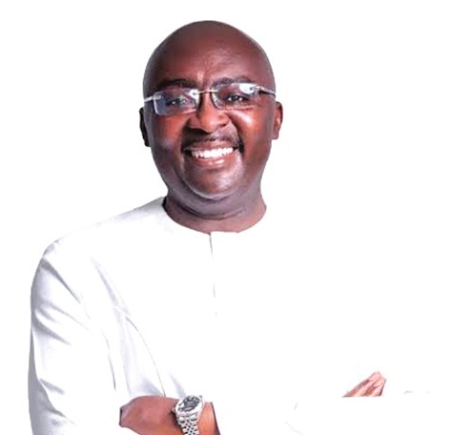
The Vice-Presidency is often described as being a heartbeat away from the Presidency — making the leap to the nation's highest office a natural, if not inevitable, ambition for those who hold it.
It is, therefore, not surprising that in 2028, Dr Bawumia’s name will be on the ballot as presidential candidate of the New Patriotic Party for a second time.
I find the political ambitions of Dr Bawumia and his predecessors intriguing — men who refuse to quit until they succeed.
The late Prof. Mills fell short in 2000 and 2004 before finally prevailing in 2008. Former President Akufo-Addo suffered defeats in 2008 and 2012 before winning in 2016.
And President Mahama, having won in 2012, endured back-to-back losses in 2016 and 2020 before reclaiming the presidency in 2024.
When I asked former President Kufuor whether he had ever considered quitting after his 1996 defeat, he offered a characteristically measured response: “The hazards of politics are like climbing a slippery slope.”
His point was simple but enduring — you keep climbing until you reach the top.
I assume it is the same motivation for Dr Bawumia – to keep climbing until the presidency is clinched.
The slippery slopes
What were the slippery slopes in 2024?
The first slippery slope was navigating the pitfall of the entrenched eight-year electoral cycle in which voters rotate power between the two major parties after two terms.
His party had no illusions about this reality, and in response, deliberately coined the phrase 'break the eight.' It was an explicit acknowledgement of the cycle and a direct appeal to Ghanaians to consciously break it.
The second slippery slope, compounding the first, was the weight of public sentiment about the state of the economy and the broader governance environment.
Well before the 2024 election, Ghanaians had rendered a clear verdict — one captured in Afrobarometer Round 9 (2022) and reinforced in Round 10 (2024).
Across virtually every dimension measured — government performance on key policy issues, the fight against corruption, trust in public institutions, and satisfaction with democracy — the data reflected deep and widespread disapproval of his party's stewardship.
There was a small bright spot in Round 10: Ghanaians expressed broad support for the party's flagship programmes — Free SHS,
One District One Factory, Planting for Food and Jobs, and One Village One Dam — with the E-Levy standing as the notable exception.
But any honest reading of the Afrobarometer survey results would concede that, taken as a whole, this too was a slope that proved impossible to climb.
The third slippery slope was the mixed blessing of incumbency.
When public sentiment toward a sitting government is broadly favourable, its candidate can draw on that goodwill as a political asset. But as the Afrobarometer data showed, sentiment had turned — and this created a narrative challenge.
How does an incumbent Vice-President reckon with public disapproval of his party's record while still upholding the principle of collective responsibility? It was a double-edged sword with no simple solution.
The fourth slippery slope was the consequences of the 2016 electoral argument against the government of then-President Mahama.
The case the party made against the Mahama administration's economic management was central to its victory that year.
However, by 2024, the country's own economic indicators between 2022 and 2024 gave the opposition ammunition to make the same argument against the incumbent party.
The party and its candidate offered a twin explanation — the effect of COVID-19 and the Russia-Ukraine war, which was not without merit.
But what I observed was that by election day 2024, that explanation had lost much of its persuasive force with ordinary Ghanaians.
When I cast my mind back to the 2024 general election, I find myself strongly arguing that no incumbent Vice-President could have prevailed under these slippery slopes.
Overcoming the slippery slopes
I have never contested an election beyond those of my undergraduate years, and, therefore, I make no claim to fully understand the mental and emotional fortitude it takes to pursue the presidency, suffer defeat, and yet summon the resolve to try again.
That means I also do not have the answers to how a candidate like Dr Bawumia overcame these slippery slopes.
In fact, by the year 2028, they may not even be slippery slopes anymore.
Whatever the case may be, I strongly believe that slippery slopes can be overcome.
His predecessors have shown that.
As to whether a four-year gap after a turnover election is enough time to get it done, that remains to be seen.
If it can be done, though, it will have to be Dr Bawumia, in my humble opinion, who emerged on the morning of the day after the 2024 election to concede defeat – the true statesman, putting country first without the constraints of partisanship.
The writer is the Director, Democracy Project.
