
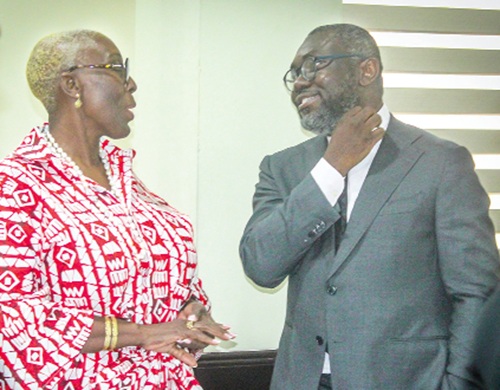
The Constitution Review Implementation Committee (CRIC) has begun its first engagement with civil society organisations (CSOs) and Organised Labour as part of efforts to review the 1992 Constitution.
The two-day engagement, which began yesterday, is being attended by representatives of the Ghana Centre for Democratic Development, Institute for Democratic Governance, Ghana Anti-Corruption Coalition, Christian Council of Ghana, Trades Union Congress (TUC), Transparency International Ghana, Institute of Economic Affairs and NETRIGHT.
The committee was inaugurated with a mandate to translate accepted constitutional reform recommendations into laws and other measures for implementation.
The Chairperson of CRIC, Marietta Brew, who opened the engagement, said the committee had carefully studied submissions made by the participating organisations, acknowledging that some of their criticisms exposed genuine differences with the government's position.
She said Ghana's democracy was founded on pluralism and that neither the government nor any organisation had a monopoly on wisdom.
However, she stressed that government decisions carried a democratic mandate that no coalition or organisation, regardless of its expertise, could claim.
Ms Brew said the government's position paper was the product of passionate disagreements within Cabinet, where competing views were debated before a compromise was reached.
She urged the organisations to identify their genuine "red lines", explaining that these should be positions they would rather see the entire referendum fail than concede.
She cautioned that treating every issue as a red line would make it difficult for the government to distinguish between positions stakeholders could compromise on and those they considered non-negotiable.
Parliamentary role
Ms Brew said bills emerging from the CRIC process would be submitted to Parliament and the Council of State, urging the CSOs to sustain their engagement by participating in parliamentary debates and sharing their views with Members of Parliament.
She also called on the organisations to mobilise their members and the public to participate in the referendum, warning that a failure to secure the required voter turnout would be a collective defeat.
She said the constitutional reform process presented Ghana with an opportunity to demonstrate that democracy could renew itself through law and constructive dialogue.
Building consensus
The Executive Secretary of CRIC, Oliver Barker-Vormawor, said constitutional reform implementation could not be undertaken in isolation, making continuous stakeholder engagement essential.
He said the engagement was intended to narrow areas of disagreement, identify contentious issues and build consensus to ensure the process reflected a genuine national undertaking.
Mr Barker-Vormawor explained that the committee would present its findings to the Attorney-General, who would subsequently submit them to Cabinet.
He said the committee's responsibility was to faithfully represent the views of Ghanaians and stakeholders on the government's proposed approach to constitutional amendments.
He added that the committee was reviewing the government's position paper alongside submissions from various organisations, noting that several of them had accepted many of the proposals put forward by the government.
