
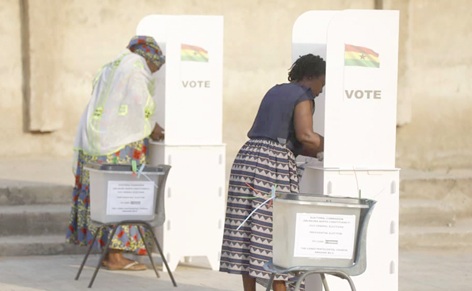
Ghana’s passage of the Affirmative Action (Gender Equity) Act, 2024 (Act 1121), is an important step towards building a more inclusive political system.
The law establishes progressive targets for women’s representation and recognises that gender equity must extend into political institutions.
But a critical question remains: Can affirmative action deliver meaningful political inclusion if the structures, financing systems and competitive processes within political parties remain largely unchanged?
This question should not be directed at one political party. Ghana’s major political parties operate within broadly similar political and financial environments, where competing for leadership can require substantial financial resources, strong networks, political sponsorship and the ability to mobilise delegates.
The recent New Patriotic Party (NPP) national executive election provides one illustration.
The party’s leadership structure continues to show women concentrated in designated women’s leadership positions, while the principal general leadership positions remain predominantly male.
This should not simply be interpreted as a question of whether women are willing or able to contest.
It should prompt us to examine the conditions under which political leadership is contested.
The same questions should be applied to the National Democratic Congress (NDC), the Conventions People’s Party (CPP), the People’s National Convention (PNC), the United Party (UP) and other political parties.
As the NDC undertakes its 2026 internal reorganisation and elections, there is an opportunity to examine whether women can compete meaningfully across the full range of leadership positions, not only within women’s structures.
This measure of inclusion applies equally to every political party. The issue, therefore, is not which party is doing better. It is whether Ghana’s political parties are collectively creating pathways for women to access political power.
Who can afford to run?
Affirmative action cannot work if we focus only on the number of women who eventually occupy positions.
We must also examine what happens before they get there.
GenCED’s research on the cost of political participation has identified filing fees, campaign expenditure, delegate mobilisation, sponsorship expectations, patronage and other hidden costs as significant barriers to women’s and young people’s political participation.
These costs extend well beyond the formal price of a nomination form.
A candidate may pay a reduced filing fee and still face substantial expenses for transportation, communication, campaign materials, meetings, accommodation, mobilisation, media visibility and networking.
Women may also carry additional unpaid care responsibilities and social expectations that affect the time and resources they can devote to political competition.
This means that reducing filing fees, although important, is only one part of the solution.
The deeper question is who has access to political resources.
Who receives financial support?
Who has access to influential party networks?
Who can mobilise delegates?
Who has political sponsors?
Who can compete for the highest leadership positions without accumulating significant financial obligations?
These questions matter because women’s representation in designated structures does not necessarily translate into women’s influence over broader political decision-making.
Women’s wings and women’s organiser positions are important.
They provide platforms for organising, mobilisation and leadership development. But meaningful inclusion requires women to be able to compete, win and exercise authority across the entire political leadership structure.
The same principle applies to young women, who may face additional barriers because of limited financial resources, shorter political networks and weaker access to established political sponsors.
Reforming the gateways
This is where the implementation of Act 1121 must become more ambitious.
Political parties should not be assessed only on how many women they have in leadership.
They should also be required to examine the pathway to leadership: Who contests?
Who receives support?
Who can afford to compete?
Who has access to delegates and influential decision-makers?
Who reaches the most powerful positions? And who exercises meaningful authority after being elected?
A cross-party accountability framework would help move this conversation away from partisan accusations and towards institutional reform.
The same indicators should be applied to the NPP, NDC and other political parties.
Political parties should publish gender-disaggregated information on their leadership structures, nomination and filing fees, candidate support and access to party resources.
They should establish transparent mechanisms to support women and young women candidates and review the broader financial costs of internal elections.
Ghana’s affirmative-action framework allows us to move beyond simply asking how many women are represented.
The more important question is whether women have equal political opportunity.
If women continue to enter political contests with fewer financial resources, weaker networks and greater social and care responsibilities, formal equality will continue to coexist with substantive inequality.
Affirmative action must,therefore, do more than open the door. It must change the conditions under which people are able to walk through it.
If political parties are the gateways to political power, then reforming those gateways must be at the heart of Ghana’s affirmative action agenda, not only counting who eventually passes through them.
The writer is the Executive Director,
Gender Centre for Empowering Development (GenCED)
