
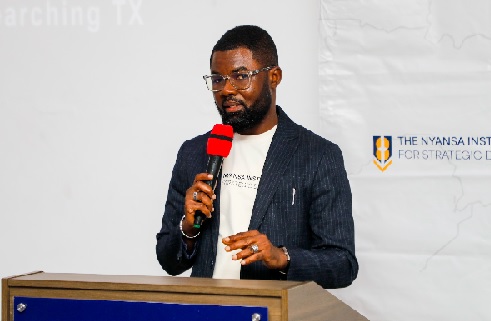
The Executive Director of the Nyansa Institute for Strategic Dialogue (NSID), Samuel Koranteng Adjei has called on Ghana to move beyond awareness of the growing instability in the Sahel and adopt a comprehensive strategy focused on preparedness, prevention and regional leadership.
Speaking at the third edition of the Nyansa Dialogue Series, held under the theme “With Growing Instability Across the Sahel, How Can Ghana Help?”, Mr Adjei said the worsening security situation in the Sahel could no longer be treated as a distant threat to Ghana.
He stated that the expansion of violent extremism, political instability, trafficking, displacement and the weakening of state authority in parts of the Sahel was rapidly reshaping the security environment across West Africa.
Although Ghana has maintained its position as a relatively stable democracy, he cautioned that the country’s stability should not be mistaken for immunity from the effects of regional insecurity.
“The question before us tonight is therefore not simply whether instability in the Sahel can reach Ghana, it is whether Ghana is sufficiently prepared for the changing nature of the threat, and whether we are exercising the leadership required to help prevent a wider regional crisis,” he said.
Mr Adjei stressed that the challenge extends beyond military and security responses, arguing that Ghana’s approach must also address governance, economic opportunities, border-community resilience, intelligence gathering and sharing, diplomacy, regional cooperation and public trust.
He observed that violent extremism often thrives in environments where state institutions are weak, young people have limited economic opportunities and communities feel disconnected from government and other institutions.
He therefore called for a response that addresses both the security and socio-economic dimensions of the crisis.
According to him, Ghana must deliberately transition “from awareness to preparedness, from preparedness to prevention, and from prevention to regional leadership.”
Mr Adjei raised a number of critical questions about Ghana’s readiness, including whether communities in the northern parts of the country are sufficiently resilient to withstand extremist influences, whether security institutions have adequate resources and coordination mechanisms, and whether intelligence is being effectively shared across national borders.
He also urged stakeholders to examine Ghana’s role in wider regional security arrangements and partnerships, including its engagement with countries such as the United States.
He emphasised that addressing the Sahel crisis should not be regarded as the sole responsibility of government or security agencies. Instead, he called for a broad national conversation involving policymakers, security professionals, traditional and community leaders, researchers, civil society organisations, the private sector, the media and citizens.
Mr Adjei said the NSID was established to provide a platform for such conversations, allowing national and regional challenges to be examined openly and constructively, with the ultimate objective of influencing sound public policy and decisive action.
He encouraged participants at the dialogue to go beyond merely describing the threats confronting the region and focus on practical measures that Ghana can adopt to strengthen its resilience and contribute meaningfully to regional stability.
“The Sahel crisis is a warning,” he said, stressing that Ghana still has an opportunity to strengthen its internal resilience and help shape the wider regional response.
However, he cautioned that the opportunity should not be taken for granted, insisting that preparations must begin before instability reaches Ghana’s borders.
“The time to prepare is not when the threat arrives at our doorstep. The time to lead is now,” he stated.
He concluded by urging participants to engage in a thoughtful and consequential discussion capable of producing practical recommendations for Ghana’s security, resilience and leadership role in West Africa.
