
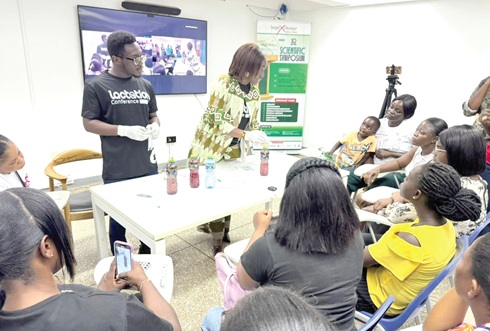
A former Deputy Director, Family Health Division of the Ghana Health Service (GHS), Dr Isabella Sagoe-Moses, has underscored the need for the government and other stakeholders to come up with policies that protect breastfeeding mothers.
“We must recognise that awareness without action is not enough.
We need healthcare facilities that provide appropriate lactation support, workplaces that enable mothers to continue breastfeeding and communities that understand their responsibility to support mothers,” she stressed.
She said it was essential to create an environment where breastfeeding by nursing mothers was not only recommended but actively protected, supported and celebrated.
Conference
Dr Sagoe-Moses made the remarks while delivering the keynote address at the opening ceremony of the Lactation Conference organised by hopeXchange Medical Centre in Kumasi in collaboration with the Paediatric Society of Ghana.
The three-day conference brought together health professionals including lactation consultants, expectant and nursing mothers, policy makers, stakeholders, community members, among others.
It was on the theme: “Breastfeeding for a sustainable start in life: Strength that works”.
It had the purpose of highlighting evidence-based strategies to promote, protect and support breastfeeding, share innovative models of breastfeeding support at community and facility levels and foster partnerships among health care providers, policymakers, researchers and civil society.
Investment in child survival
She said breastfeeding was more than another option for feeding infants but rather an investment in child survival, growth and development, maternal health, family wellbeing and the future of the nation.
Yet, she mentioned that breastfeeding mothers often encountered barriers that could not be solved by them alone, emphasising that these barriers may exist within healthcare facilities, workplaces, homes, communities, and even within our policies and systems.
“We therefore need a holistic approach in which healthcare professionals, families, employers, policymakers, traditional and community leaders, professional associations, the media, development partners, and government all play their part”, she said.
The guest of honour, the Nkosuohemaa of Afigya Kwabre, Nanahemaa Adjoa Awindor, said breastfeeding was far more than the provision of nourishment, saying, “It is an investment in the health and future of a child”.
She said, “It supports growth and development, strengthens the bond between mother and child, and provides a foundation upon which a healthy life can be built”.
Yet, despite its enormous benefits, she said many mothers continued to face challenges that made successful breastfeeding difficult and called for the creation of an enabling environment in which mothers were informed, equipped, encouraged, supported and protected throughout their breastfeeding journey.
A Senior Resident, Paediatric Surgery Unit, the Komfo Anokye Teaching Hospital (KATH), Dr David Kofi Nyarko, said the needs of a newborn may not only be medical but may also include a surgical component.
He emphasised that professionals who man the Neonatal Intensive Care Unit (NICU) of health facilities should be able to recognise, stabilise and refer promptly, saying that for common neonatal surgical conditions, staff at the NICU, irrespective of their specialisation, should be able to identify and attend to any emergency condition of a newborn.
