
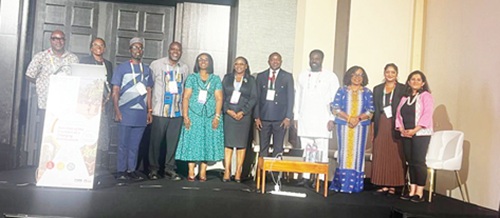
Panellists at a meeting on nutrition supplementation have called on the government to translate its nutrition commitments into funded priorities, implementation and measurable results for women, children and vulnerable communities.
They made the call at a breakfast meeting in Accra last Thursday, convened by Women Media and Change (WOMEC) on the sidelines of the Micronutrient Forum Global Conference and sponsored by the Eleanor Crook Foundation (ECF), on the theme “From Commitment to Action: Government Leadership for Sustainable Nutrition in Ghana”.
The panellists were Professor Titus Beyuo, Member of Parliament (MP), Lambussie, Olivia Mawunyo Timpo, Ghana Health Service, Prof. Richmond Nii Okai Aryeetey, University of Ghana, Legon, Dr Senanu Kwesi Djokoto, National Health Insurance Authority and Dr Maame Nkansaa Asamoa-Amoakohene, Clinton Health Access Initiative.
Timing
Prof. Beyuo, in his remarks, said academia, civil society and some agencies sometimes miss the correct timing for advocacy.
He said governments come into power with a manifesto promise that forms a social contract with the people, and if advocates have not convinced political parties at the point of preparing manifestos, it becomes difficult to get them to deliver on alternative evidence after they assume office.
His advice, he said, was for academics and civil society to start engagement with political parties early so ideas become part of manifestos, and when that window was missed, to identify government priority areas and ride on them, rather than introduce entirely new demands.
He concluded that a nation must have pride in being able to feed its own people, saying a nation that cannot take care of its most vulnerable, including pregnant women and malnourished children, has a dead conscience.
Ms Timpo, for her part, said the delivery of Multiple Micronutrient Supplementation (MMS) to pregnant women was currently co-financed by government and external partners, with government covering personnel and infrastructure costs.
She explained that the initial costs of training staff who care for pregnant women – including midwives, physician assistants, doctors and gynaecologists were paid for by government, as well as facilities, cold storage and the database for data capture and distribution systems.
Dr Djokoto, for her part, said the NHIA has established guidelines for inclusion of new interventions into the National Benefits Package, saying the authority was responsible for every health participant within the country and that its Benefits Package from 2003 captured a number of nutrition interventions, but changing landscape required processes for inclusion of new ones.
Prof. Aryeetey said researchers wanted tested interventions that worked to be implemented at scale, but financing gaps prevented uptake and interventions remained thin on the ground.
Standard treatment
Dr Asamoa-Amoakohene said inclusion of Ready-to-Use Therapeutic Food (RUTF) and Multiple Micronutrient Supplements (MMS) starts with listing them in the standard treatment guidelines and essential medicines list.
The Director-General of the National Development Planning Commission, Dr Audry Smock Amoah, who chaired the meeting, said the NDPC saw planning as the surest way to connect national priorities with programmes and budgets across sectors and the levels of government.
She said the country’s development framework provided the basis for integrating nutrition priorities into development planning but said: “The challenge for us is to strengthen that connection, to make sure that priorities are clearly stated, appropriately posted, adequately resourced and monitored for results.”
In her welcome address, Dr Binka said through its “Nourish Ghana: Advocating For Increased Leadership to Combat Malnutrition in Ghana” project, supported by ECF, WOMEC has been working to strengthen leadership, financing and accountability for nutrition through strategic partnerships, advocacy and media engagement to keep nutrition on the public and policy agenda.
