
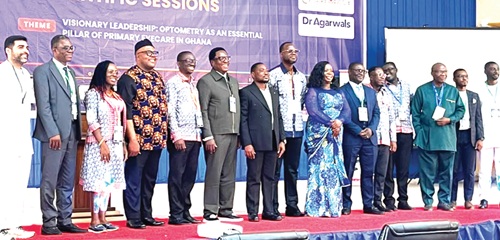
The Ghana Optometric Association (GOA) has called for the integration of comprehensive eye care into all levels of primary health care to address preventable blindness and improve access to essential eye services, particularly in underserved communities.
It said the inadequate distribution of qualified optometrists and the cost of eye examinations continued to limit access to timely diagnosis and treatment, exposing many Ghanaians to avoidable vision loss.
The President of the GOA, Alfred Gardemor, made the call at the association’s 14th Annual General Meeting (AGM) and Scientific Sessions held at the University of Cape Coast (UCC), which brought together optometrists, health sector regulators and other stakeholders.
The meeting was held on the theme: “Visionary Leadership: Optometry as an Essential Pillar of Primary Eye Care in Ghana”, and was sponsored by Canada Optical Laboratory Limited and Dr Agarwals Eye Hospital.
He said optometrists were often the first point of contact for people seeking eye care and played a critical role in detecting, managing and referring conditions such as cataracts, glaucoma, refractive errors and diabetic retinopathy.
Dr Gardemor urged the government to strengthen policies that would ensure equitable distribution of optometrists across the country and expand National Health Insurance Scheme (NHIS) coverage for essential eye care services and increase investment in eye health infrastructure.
He warned that failure to deploy qualified optometrists to remote communities could create opportunities for inadequately trained persons to provide services beyond their competence.
He also encouraged practitioners to embrace technological innovations, strengthen research and promote public education to counter harmful myths and unsafe traditional remedies that could result in irreversible blindness.
The event also saw the induction of 106 optometrists into the profession.
The Director of the Eye Care Secretariat at the Ghana Health Service (GHS), Hornametor Afake, said Ghana needed to double its annual cataract surgeries to about 68,000 to address the backlog of patients living with blindness caused by the condition.
He said the country performed approximately 34,000 cataract surgeries in 2025, representing about half the estimated annual requirement, and called for intensified efforts to expand access to treatment.
Dr Afake said the national prevalence of blindness stood at 0.74 per cent, representing more than 250,000 people, with cataracts accounting for 54.8 per cent of cases.
Early intervention
The Chief Optometrist at the Korle Bu Teaching Hospital, Samuel Owusu Asiedu, said primary eye care was critical to detecting treatable conditions early and preventing avoidable blindness.
He added that more than half of blindness cases in Ghana were attributable to cataracts, while glaucoma remained a leading cause of irreversible blindness.
He said rural and peri-urban communities were particularly affected by limited access to eye examinations, with some patients having to travel long distances to obtain care.
Dr Asiedu called for the fuller integration of optometric services into the NHIS so that the cost of an eye examination would not prevent people from seeking care.
He also advocated the expansion of services to underserved districts, the adoption of telehealth, where feasible, and stronger collaboration among optometrists, ophthalmologists, nurses and public health professionals.
Metropolitan initiative
The Metropolitan Chief Executive (MCE) for Cape Coast, George Justice Arthur, announced plans for the Cape Coast Metropolitan Assembly (CCMA) to introduce a primary eye care plan for 2027 to 2030.
He said the assembly would partner the GOA and UCC to conduct eye screening in basic schools and among commercial drivers in the metropolis.
