
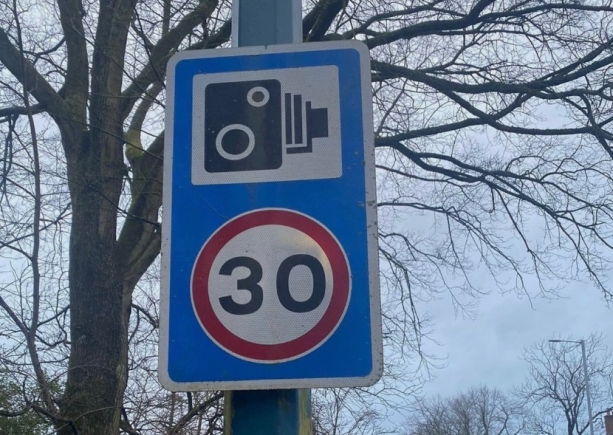
Following public concerns by some motorists that there are inadequate or non-existing road signs in various areas in Ghana, directing or alerting motorists especially at a time cameras (Traffitech-Gh) have been deployed to enforce traffic laws, the Police Motor Transport and Traffic Department (MTTD) has hinted that, it was working with a road engineer to fix that challenge.
The move, which is to ensure the visibility of all road signs is to also fix speed camera signs on various selected roads where the MTTD are to be enforcing traffic laws using cameras (Traffitech-Gh).
At the moment, there are no speed camera signs on many roads in Ghana.
In some areas where there are speed limit signs, they either have defects or have broken down without being replaced.
But in all this, the MTTD has explained that there are conventional landmarks incorporated in the Road Traffic Regulation which all motorists and cyclists are supposed to know and use where there is no physical speed limit signs installed by the road engineers.
In a radio interview monitored by Graphic Online on Accra based Joy FM on Tuesday morning, the Director of Education, Research and Training at the MTTD, ACP Alexander Kwaku Obeng, said as part of "best practices moving forward, we have engaged a road engineer, by the proactive decision of the Inspector General of Police (IGP) to examine best practices in gathering evidence"
ACP Obeng said the "road engineer is to embed a certain form of conventional camera on most of our signs including the gantry, informatory signs that we have, indicating a road that you are entering and then embed those signs. So moving forward, you will begin to see all these. However, in addition, we will have to sensitise so we have begun with sensitisation that our cameras are monitoring all roads
He said the camera symbols would be incorporated into various road signs, including overhead gantry signs and information signs indicating the roads motorists will be entering.
“Moving forward, we begin to see all these things,” he said, referring to the proposed introduction of camera signs on roads".
Speed limit signs
Responding to the public concerns, ACP Obeng disputed claims that the police were enforcing speed limits on roads without the necessary signage.
- Read also:
- See the 4 lawful landmarks for speed limits on Ghanaian roads where there are no physically installed speed limit signs by road engineers
- TraffiTech: MTTD explains how during an emergency, motorists rushing patients to hospital can contest speeding fines
He explained that the routes currently monitored under the TraffiTech-GH system had been selected because speeding had become a major road safety concern.
He said many of the roads had visible speed-limit signs, road markings and other traffic signs to guide motorists.
He mentioned the Bortianor stretch, Boundary Road, the Burma Camp area and sections of the Accra-Kasoa and Accra-Nsawam roads as examples of routes with speed-limit signs.
According to him, motorists continued to exceed the prescribed limits despite the presence of the signs, with some travelling at speeds of 130km/h and 140km/h on roads with a 50km/h speed limit.
ACP Obeng also cautioned motorists against assuming that enforcement cameras would always be visible, explaining that some could be mounted or embedded in police vehicles approaching or moving away from them.
He urged drivers to observe speed limits at all times rather than wait to see enforcement equipment before adjusting their speed.
Camera warnings
The proposed introduction of camera symbols would serve as an additional public information measure and would not be a legal requirement for the police to enforce speeding offences.
The TraffiTech-GH system, which started full implementation on November 1, 2026, is initially targeting speeding offences.
