
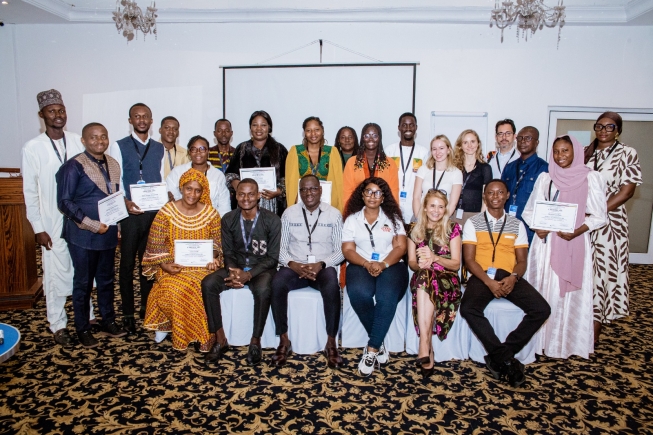
A three-day training programme aimed at strengthening the capacity of journalism educators and media professionals to detect disinformation and address emerging threats posed by artificial intelligence to journalism has ended in Accra.
The STREAC (Strengthening Resilience and Competence in the Field of Disinformation in the Sahel) Autumn School brought together 12 participants from 10 countries across the Sahel and West Africa for expert-led sessions, practical workshops, comparative research presentations and peer exchanges.
The programme, which opened on November 11, 2026, was designed to improve media and information literacy and equip journalism educators with practical skills to prepare journalists to identify and tackle information manipulation.
It was funded by the German Federal Foreign Office in partnership with the Erich-Brost Institute for International Journalism at TU Dortmund University in Germany and the University of Education, Winneba (UEW).
Practical tools
The Director of the Erich-Brost Institute for International Journalism, Professor Susanne Fengler, said journalism educators had a crucial role to play in building media literacy and preparing journalists to deal with the growing challenge of disinformation.
She said the ability to identify false information, verify claims and distinguish credible sources had become increasingly important for journalists operating in a media environment where misleading content could spread rapidly.
Prof. Fengler said the training was therefore designed to go beyond discussions on the dangers of disinformation by equipping participants with practical tools they could incorporate into journalism education.
She said the participants were expected to use the knowledge and skills acquired to strengthen the training they offered to journalists and students in their respective countries.
Prof. Fengler added that the knowledge and findings from the programme would be developed into an online learning module to make the training resources accessible to journalism educators and media practitioners beyond those who attended the Autumn School.
She said the approach would help extend the benefits of the initiative and support continued efforts to strengthen professional responses to disinformation across the region.
Verification
For his part, a facilitator at the programme, Azil Momar Lo, said fact-checking and verification should not be regarded as the exclusive responsibility of specialised fact-checkers, but as a fundamental part of journalism.
“Verification and fact-checking is not only for fact-checking professionals. Basically, it is journalism. You can't inform people while you don't verify, you don't check your information before you publish,” he said.
He urged journalists to slow down, check information and verify claims before publication, particularly at a time when false reports could spread across countries within seconds.
Mr Lo also called on fact-checkers to make their findings accessible by presenting them in simple language, so that verification would not be seen as an elite practice.
He said members of the public should also develop the skills to verify information independently rather than rely solely on professional fact-checkers.
He said the training had provided participants with practical guidance on designing and delivering training sessions, including preparing materials in advance, understanding the needs of participants and adapting content to different contexts.
Mr Lo described the programme as an opportunity for professionals from different countries to share experiences, learn from one another and build networks to respond to changing trends in the media and disinformation landscape.
