
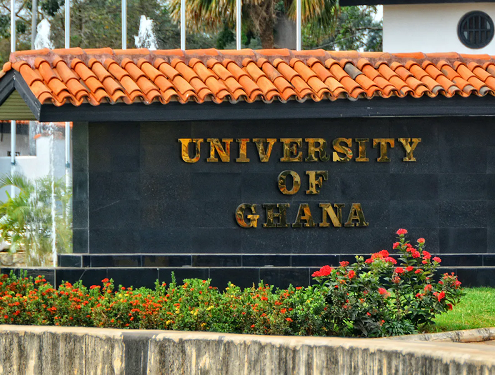
The University of Ghana (UG) has reduced its proposed accommodation fee for students in four Diaspora halls for the 2026/2027 academic year from GH¢8,820 to GH¢8,050 following consultations with student leaders.
The revised annual charge for students occupying standard four-bed rooms represents a reduction of GH¢770 from the initial proposal.
The new fee is, however, GH¢1,050 higher than the existing annual charge of GH¢7,000.
The University announced the reduction in a statement issued through the Office of the Registrar on November 19, 2026, following concerns over hostel charges, the condition of some residential facilities and a confrontation involving the University of Ghana Enterprises Limited (UGEL) and the Rent Control Department.
Explaining the basis for the charges, the University said several residential facilities managed by UGEL had been constructed with commercial loans secured to expand student accommodation at a time when public funding was inadequate.
It said the accommodation fees were intended to cover loan repayments, utility bills, maintenance and other operational expenses.
The University described UGEL as its wholly owned subsidiary, established to undertake commercial activities on its behalf, including the provision of student accommodation.
It added that UGEL-managed halls operated under the University's governance and regulatory arrangements, as provided for under the University of Ghana Act, 2010 (Act 806), and the University of Ghana Statutes, 2024.
Management acknowledged the financial burden accommodation charges placed on students and their families but said the University had to balance affordability with the long-term financial sustainability of the residential facilities.
The University also expressed regret over a confrontation during an inspection of some UGEL-managed residential facilities on Tuesday, November 17, 2026.
It said everyone acting on behalf of the University was expected to conduct themselves professionally and respectfully, including during disagreements.
Management said the circumstances surrounding the incident would be reviewed and appropriate action taken where necessary.
Although the University recognised the mandate of the Rent Control Department, it raised legal questions about whether the Rent Act, 1963 (Act 220), and the Rent Control Act, 1986 (P.N.D.C.L. 138), applied to student accommodation.
It said the matter required clarification, taking into account the nature of the agreement between UGEL and students.
The University maintained that concerns about the operations of UGEL-managed residential facilities should be addressed through engagement and established procedures.
It said it was prepared to engage the Rent Control Department and other relevant authorities to resolve the matter.
Hostel conditions
On complaints about the condition of some residential facilities, the University acknowledged concerns over sanitation, maintenance and other deficiencies.
It said students deserved safe and decent accommodation and disclosed that renovation works had started in phases.
Management explained that major rehabilitation works were traditionally undertaken during the long vacation, when most halls were unoccupied.
It said changes to the academic calendar had shortened vacation periods, leaving less time for extensive maintenance and renovation works.
The University added that major construction activities could not safely be undertaken while students were occupying the halls because of the risks involved and the disruption they could cause.
In response to the concerns, UGEL has been directed to prioritise urgent repairs, improve sanitation and pest control, and prepare a phased rehabilitation programme for facilities requiring extensive work.
Management said the measures were intended to improve conditions in the halls and provide students with safe and functional accommodation.
GTEC intervention
The University has welcomed an initiative by the Minister for Education for the Ghana Tertiary Education Commission (GTEC) to engage the Rent Control Department on the regulation of accommodation fees in tertiary institutions.
Management said it was ready to participate in the discussions and provide financial and operational information about its residential facilities to help determine a fair and sustainable accommodation fee.
It said it would also continue engaging student leadership, including the Students' Representative Council (SRC) and the Graduate Students' Association of Ghana (GRASAG-UG), on accommodation fees and hostel conditions.
The University assured students that they could raise legitimate concerns about their accommodation without fear of victimisation.
Students experiencing financial difficulties were also encouraged to seek assistance through the appropriate University channels, including UGEL and the Student Financial Aid Office.
The University said it would continue to balance affordable accommodation with the financial sustainability of its residential facilities while undertaking improvements to the
