
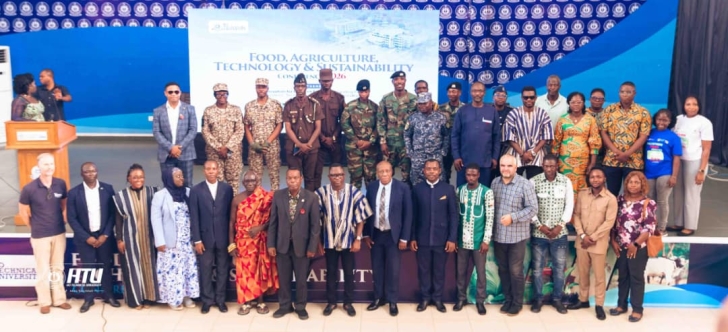
A two-day Food, Agriculture, Technology and Sustainability (FATAS) conference has ended in Ho with a call on stakeholders in agriculture and industry to translate research into resilient food systems and improved food security within a sound environment.
The conference, the second of its kind, was organised by the Ho Technical University (HTU) in conjunction with the Ghana Circular Economy Centre. It was held under the theme: "Innovation for Resilient Futures – Integrating Food Systems, Technology and Sustainable Agriculture," and was attended by 12 delegates from Nigeria, Germany and Ghana, alongside participants from various sectors.
Climate change and national security
Speaking at the opening on Wednesday, November 11, seasoned agronomist Professor John Ofosu-Anim warned that the impact of climate change, declining soil fertility, rising production costs, post-harvest losses and low farm yields threatened national security.
He therefore called on universities and research institutions to bridge the gap between research and practice by translating their scientific findings into affordable and accessible solutions for farmers.
In that regard, he urged higher educational institutions to take advantage of emerging research funding opportunities to promote agricultural commercialisation.
Professor Ofosu-Anim commended HTU for its strength in applied technology and engineering, stating that the university had the potential to become a hub for agricultural research and strategic partnerships in the Volta Region and beyond.
AI and food safety
A professor of Agri-Food Integrity Engineering at the University of Cape Coast, Professor Ernest Teye, called for the adoption of artificial intelligence, digital traceability and other technologies to strengthen food safety and quality assurance.
He mentioned the limitations of conventional laboratory testing and advocated rapid, non-destructive technologies to detect food adulteration and verify product authenticity.
Professor Teye touched on the need for transparency, environmental responsibility and respect for farmers, stressing that technological innovation must be readily accessible and responsive to the needs of stakeholders across the agricultural value chain.
"Building trust in food systems is as important as increasing production, particularly as consumers demand safer and more traceable food," he explained.
Commitment to applied research
The Vice Chancellor of UHAS, Professor Ben Q. Honyenuga, said the university would remain firmly committed to applied research, innovation and sustainable development.
He gave an assurance that HTU would continue to focus on knowledge that solved real problems, trained graduates for industry and supported communities to improve their livelihoods through technology and entrepreneurship.
Professor Honyenuga maintained that HTU's role as the host institution of the UNIDO-Ghana Circular Economy Centre also positioned it to champion circular approaches that turned waste into value and promoted responsible resource use.
The Pro-Vice Chancellor of HTU, Professor Christopher Mensah, said it was important to leverage science, technology, digital innovation and sustainable resource management to build resilient food systems.
He added that the persistent challenges confronting Ghana's agricultural sector required stronger collaboration among universities, government, industry, farmers and development partners.
Turning waste into wealth
The Volta Regional Minister, James Gunu, in a speech read on his behalf, reiterated the need for the conversion of agricultural waste into useful resources.
That, he said, required increased private sector investment to make agriculture more productive, profitable and attractive to young people.
"The future of agriculture depends on making the sector a viable business through technology, access to finance and supportive policies," he added.
