
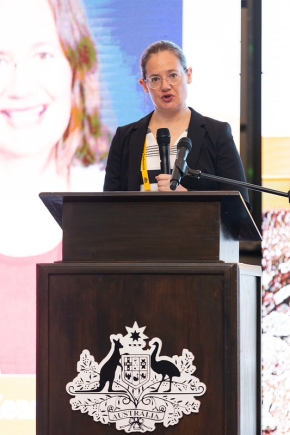
The Australian High Commissioner-designate to Ghana, Keara Shaw, has called for a broader understanding of security in Africa’s mining sector, arguing that security must protect people and legitimate economic activity while responding to organised crime and environmental risks.
Speaking at the sixth West Africa Mining Security Conference in Accra, Shaw said the long term sustainability of mining in Africa would depend on bringing security, responsible environmental practice and constructive dialogue together rather than treating them as separate concerns.
Her remarks came as government officials, mining executives, security professionals, diplomats and analysts gathered in Accra to examine the changing risk environment confronting mining operations and investment across West Africa.
Shaw said security should serve as a force that protects people and safeguards legitimate economic activity while also addressing organised crime and environmental challenges affecting the industry. She also described WAMS as a practical platform for exchanging experience and strengthening collaboration around emerging threats.
The argument reflects a widening definition of mining security across the region. Physical protection of mine sites remains important, but companies and governments are increasingly dealing with risks that sit outside the traditional perimeter of an operation, including community tensions, illicit mineral flows, border vulnerabilities, political uncertainty and environmental pressures.
Ghana’s Deputy Minister for the Interior, Ebenezer Okletey Terlabi, reinforced that point, telling the conference that protecting West Africa’s mineral economy could no longer be reduced to securing mine sites.
Terlabi said the evolving threat environment required stronger coordination among government institutions, security and intelligence agencies, mining companies, financial institutions, border authorities and host communities. He said mining security must increasingly be treated as part of the wider national and regional security architecture.
He also argued that security partnerships should be adapted to local conditions rather than simply importing models developed elsewhere.
Shaw’s intervention placed particular emphasis on the relationship between security and sustainable mining. Her message was that investment, environmental responsibility, community confidence and security cannot be considered in isolation if mining projects are to remain viable over the long term.
Nigel Stanier, Assistant Secretary for the Africa Branch at Australia’s Department of Foreign Affairs and Trade, was also among the senior Australian officials participating in this year’s conference. Stanier heads DFAT’s Africa Branch and was listed among the speakers for WAMS 2026.
The conference was hosted by the Australian High Commission in partnership with the Australia Africa Minerals & Energy Group and MS Risk.
For Shaw, the value of the gathering was ultimately practical: bringing together people who see different parts of the same security problem and creating space for them to compare experience, test assumptions and identify areas where cooperation can be strengthened.
