
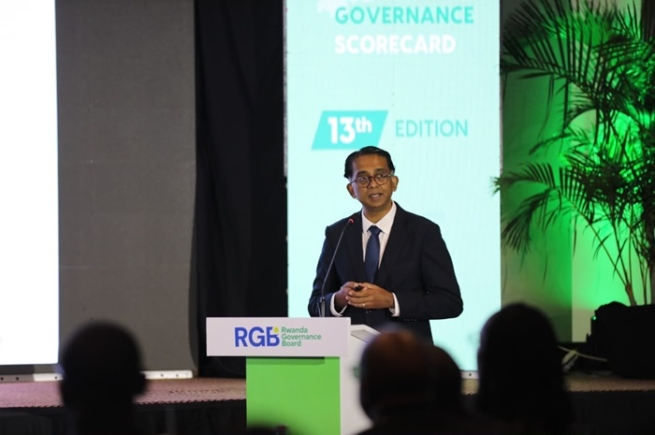
Rwanda has launched the 13th edition of its Governance Scorecard to assess institutional performance, identify governance gaps and guide reforms to improve public service delivery and outcomes for citizens.
The assessment, presented alongside the 2026 Chandler Good Government Index, is expected to inform policymaking and institutional reforms as Rwanda implements its Second National Strategy for Transformation (NST2) and advances towards Vision 2050.
Stronger coordination
Addressing the gathering at the event, held in Rwanda on Thursday (October 22), the Rwandan Minister of Local Government, Hambimana Dominique, called for stronger coordination among public institutions and more effective implementation of policies to address weaknesses identified by the scorecard.
He said overall governance performance remained stable, with five of the eight pillars scoring above 80 per cent. Safety and security led with 90.1 per cent, followed by anti-corruption, transparency and accountability at 85.8 per cent.
However, he said quality of service delivery declined by 3.2 percentage points, from 71.7 per cent to 68.4 per cent, while investment in human and social development improved from 64.2 per cent to 68 per cent.
Mr Hambimana said the results reflected citizens’ experiences and called for stronger coordination, effective policy implementation and better resource allocation, particularly at the local government level.
He also urged authorities to simplify digital services and incorporate the findings into planning, budgets and performance contracts to improve access to education, healthcare and other essential services.
Good gov’t index
Presenting the Chandler Good Government Index, the Director of Knowledge at Chandler Governance Group, Mr Dinesh Naidu, said Rwanda significantly outperformed expectations based on its Gross Domestic Product (GDP) per capita, ranking 61 places above its predicted position among the 133 countries assessed.
The index, which covered countries representing 94 per cent of the world’s population, also placed Rwanda at the top among the 13 low-income countries included in the assessment.
On specific governance measures, Dr Naidu noted that Rwanda placed 11th globally in leadership and foresight, second in long-term vision, third in adaptability and eighth in stable business regulations. It also ranked 22nd in both the quality of the judiciary and non-discrimination, and 24th in coordination.
However, he identified human development and trade as areas requiring improvement, as Rwanda ranked 111th in education, 124th in employment, 128th in income distribution and 130th in international trade.
According to Dr Naidu, the findings highlighted the need to translate strong government capabilities into better outcomes for citizens.
Commendation
The UNDP Resident Representative in Rwanda, Dr Fatmata Lovetta Sesay, commended the government and the Rwanda Governance Board for embracing accountability and developing the scorecard as a home-grown governance assessment tool.
She said the scorecard, introduced in 2010, had supported evidence-based policymaking, public dialogue and institutional reforms, stressing that its value lay in ensuring recommendations were implemented to improve public services.
Dr Sesay urged stakeholders to address underperforming indicators and avoid complacency in areas with high satisfaction levels, emphasising that the ultimate objective was to ensure quality public services for every citizen.
She reaffirmed the United Nations’ commitment to supporting governance reforms and institutional strengthening, describing good governance as essential to economic transformation, inclusion and sustainable development.
