
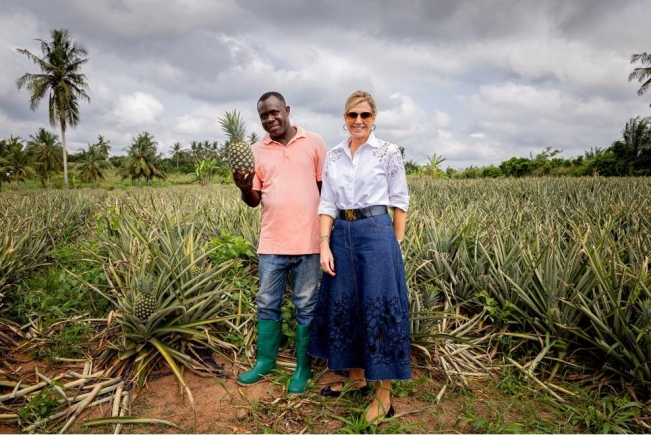
Her Majesty Queen Máxima of the Netherlands, in her capacity as the United Nations Secretary-General’s Special Advocate for Financial Health, visited Ghanaian agribusinesses working with IDH Ghana to see how locally led enterprises connect smallholder farmers to markets, finance, and decent jobs.
The visit, held on November 3, 2026, highlights IDH Ghana’s approach to strengthening agricultural markets by working with businesses and public and private partners to address barriers that prevent farmers and agribusinesses from growing.
By helping small and medium-sized enterprises to aggregate, process and sell what farmers grow, IDH supports stronger commercial relationships across value chains and creates more reliable opportunities for rural communities, whilst improving the financial health of rural households.
The approach is particularly relevant as Ghana seeks to strengthen domestic food production and make agricultural value chains more resilient. Increased production alone cannot guarantee better incomes or a more secure food supply; farmers also need reliable buyers, businesses need access to finance, and produce needs routes to market and processing capacity.
"Ghana’s agricultural opportunity is not only about growing more food; it is about building the markets that allow farmers and businesses to thrive," said Robert Asugre, Country Director of IDH Ghana. "By connecting smallholders to buyers, finance and enterprises that can aggregate and process their produce, we can help turn agricultural potential into more dependable incomes, jobs and stronger local food systems."
During the visit, Queen Máxima interacted with three Ghanaian businesses demonstrating different parts of the same market system. FarmMate, a wholly Ghanaian-owned agricultural value-chain company founded in 2022, works with tomato farmers to improve access to seeds, inputs, irrigation, technical advice, crop insurance and guaranteed seasonal prices. It links farmers to markets and processes surplus tomatoes into puree, helping reduce post-harvest losses. Its partner profile reports guaranteed market access for more than 3,000 farmers and an annual farmer payment potential of approximately US$12.5 million at full operational scale, with operations expected to support around 9,600 year-round farm jobs.
AgroCenta, a Ghanaian agri-fintech platform founded in 2016, connects grain farmers, particularly in Northern Ghana, with buyers, finance, market information, storage and logistics. Since 2018, AgroCenta has facilitated the distribution of more than 70,000 metric tonnes of food, reporting a 50 per cent increase in women’s participation as primary agricultural producers in the areas it serves. WamiAgro serves more than 60,000 smallholder farmers across six regions through Pukpara, a platform that manages farm credit and provides access to quality inputs, training, financial literacy support and weather information in local languages. The company reports that it has deployed more than US$600,000 in input finance to approximately 5,000 farmers, with a portfolio recovery rate of around 95 per cent and yield increases of up to 44 per cent among participating farmers.
IDH Ghana works with public and private sector partners across cocoa, grains, vegetables and soy, focusing on strengthening the SMEs that aggregate, process and sell farmers’ produce. Young women and youth are central to this work. Through the Grains for Growth partnership with the Mastercard Foundation, IDH reached 49,651 farmers and supported 170,745 young people to access work. Building on this, the Women in Sourcing and Enterprise programme works with 16 SMEs across seven regions in Ghana, targeting 125,000 jobs, with 80 per cent intended for young women and youth. The Making Agrifood Markets Accessible for Soy Farmers programme, funded by the Royal Norwegian Embassy, aims to reach 10,000 farmers, 60 per cent of them women, and enable 20,750 jobs from 2026 to 2028.
Queen Máxima’s visit to Ghana, from November 2 to 5, 2026, aims to explore how Ghana can build on its high levels of financial inclusion to improve people’s financial health and resilience. The field visit also included a tour of the factory of HPW Ghana in the Upper West Akim District, the largest producer of dried tropical fruits in West Africa, focusing on workplace financial health and agri-tech.
