
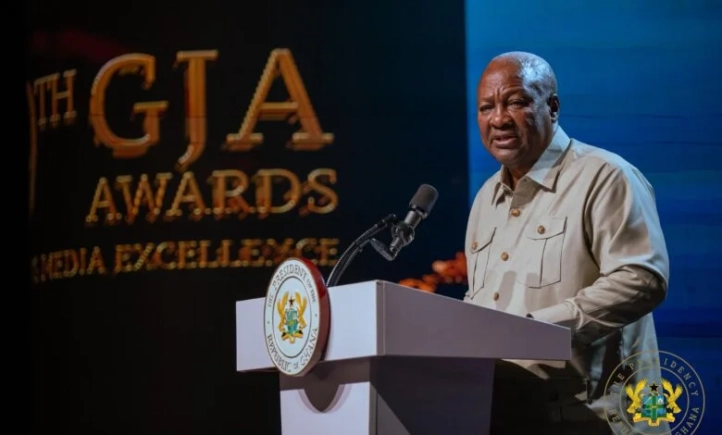
President John Dramani Mahama has urged ministers and other public officials to account for delays in government projects and provide journalists with clear answers on how public funds are spent.
He said public officials must be open about delays, explain the reasons behind stalled projects and tell affected communities when work is expected to resume or be completed.
President Mahama made the call at the 30th Ghana Journalists Association (GJA) Media Awards in Accra on Saturday, November 7, 2026.
The ceremony was held on the theme: “Celebrating Excellence, Advancing Media Freedom, and Combating Hate Speech in the Digital Age”.
He said the right of access to information was meaningful only when public officials responded appropriately to requests for information.
“A reporter who is asking how public money has been spent should receive a clear answer,” he said, adding that supporting records should be provided where disclosure was required.
President Mahama said communities deserved clear information when government projects were delayed.
“If a project is late, explain the delay and tell the community what to expect next,” he said.
He said public officials must also accept responsibility when government departments made mistakes and explain the steps being taken to correct them.
“That is how citizens can judge whether their concerns are being heard or ignored,” he said.
Accountability
President Mahama reminded public officials of the government's pledge to run an accountable and transparent administration.
“To my colleagues in public office, we made a pledge to run an accountable and transparent government. Answer difficult questions with the same openness you bring to announcing your achievements,” he said.
He said public officials, including the President, must be prepared to answer difficult questions, explaining that such scrutiny helped leaders establish whether information presented to them during official briefings reflected the realities on the ground.
Having served both as someone who asked questions and as a person required to answer them, he said, he understood the importance of allowing public officials to be questioned.
He said the government's respect for press freedom was best demonstrated “when it is asked a question it would rather avoid”.
Standards for newsrooms
President Mahama also urged journalists to uphold professional standards in their reporting, saying they must apply the same standards of evidence to the government, the opposition and other people seeking to influence public debate.
He said people facing serious allegations must be given a fair opportunity to respond, while news organisations must make corrections accessible to their audiences.
While assuring journalists that his government would respect their responsibility to hold public officials accountable, he cautioned against deliberate attempts to manufacture scandals.
He said such practices distracted from the business of serving the people.
“We will uphold your right to exercise your mandate, even when you ask us the most difficult questions,” he told the journalists.
