
Poor economic conditions confronting journalists in Ghana are severely affecting the country's performance on the World Press Freedom Index, the President of the Ghana Journalists Association (GJA), Albert Kwabena Dwumfour, has said.
He said economic factors had become an important component of press freedom assessments since 2019, making improved working conditions and better remuneration for journalists critical to strengthening media independence and restoring Ghana's position on the global ranking.
Mr Dwumfour, therefore, appealed to Parliament to support the drafting of legislation to improve the economic welfare and conditions of service of journalists in the country.
He said the proposed legislation would help address the financial challenges confronting media practitioners and strengthen their capacity to perform their constitutional mandate professionally, independently and responsibly.
Appeal to Parliament
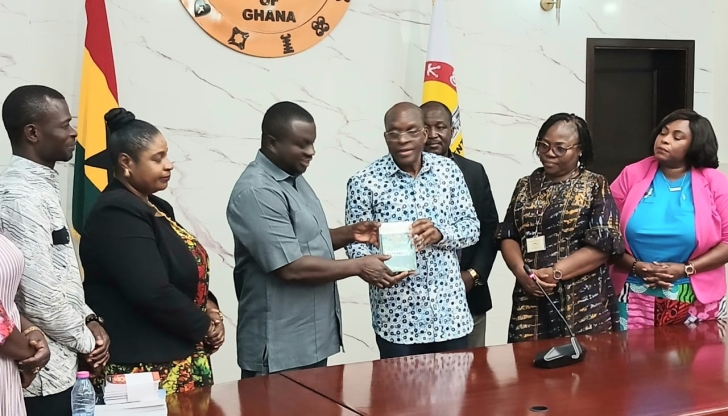
Speaking during a courtesy call on the Speaker of Parliament, Alban Sumana Kingsford Bagbin, at his office at Parliament House on October 27, Mr Dwumfour said: "We are ready to partner with our donors and sponsors, who are also ready to support us, to sponsor that Private Member's Bill to look at improved working conditions for journalists."
He made the appeal when he led a four-member executive of the GJA to invite the Speaker as a special guest to the 30th GJA Media Awards, scheduled for November 7, 2026, where he is expected to receive special recognition for his contribution to media development.
Sharp decline
Mr Dwumfour said Ghana's decline on the World Press Freedom Index in recent years could not be attributed solely to physical attacks on journalists, as economic conditions had also become a significant factor in assessing press freedom. "Since 2019, they introduced new indices and one of the indices was the economic indices and that has affected us greatly in our position on the workers' freedom index," he said.
He expressed confidence that improving the economic circumstances of journalists would contribute to strengthening Ghana's standing on the index. "And so once that is improved, we can be rest assured that Ghana will take its rightful position," he added.
Mr Dwumfour said Ghana had historically maintained a strong position on the African continent, ranking between first and third in previous years. He said sustained efforts by the current GJA leadership had helped improve the country's standing, with Ghana currently ranked fourth in Africa and 39th globally, according to the association.
He appealed to the Speaker to use his leadership position to help secure parliamentary support for the proposed legislation. "I know with your fatherly love and leadership, you can help us get to that promised land, to achieve this objective," he said, while commending the Speaker for his continued support for the media and his engagement with journalists on their professional and economic challenges.
Critical public service
In response, Mr Bagbin described journalism as a critical public service and called for formal and well-established conditions of service for media practitioners. He said although many media organisations were established and operated by private individuals, journalism should not be treated solely as a conventional commercial enterprise because of its significance to society and democratic governance. "This is because the products journalists produce are critical public goods. They are not private businesses," he said.
Mr Bagbin said journalism played an essential role in shaping society, influencing governance and providing citizens with the information they needed to make informed decisions. He stressed that political leaders also depended on the media to communicate their ideas and engage the public. "The politician only succeeds when he partners with you," he said, emphasising the need for cooperation between political leaders and journalists.
Protection of journalists
Mr Bagbin expressed concern about attacks on journalists, saying disagreements with media practitioners should not result in hostility or violence. "I find it difficult that people will lose their cool and go to attack a media person," he said.
He pointed out that without journalists, it would be difficult for society to survive, let alone hold those in power accountable. He argued that it was not for nothing that the media were referred to as the Fourth Estate. "It is because that is truly oxygen for society and governments, for without journalism, I do not think that society will survive," he said, adding that "it is the press that blows fresh air into rather very dark and environmentally polluted atmosphere of governance and politics".
Advocating the need for the press to be a partner of Parliament since it was the anchor of democracy, Mr Bagbin said it was the media that constitutionally had been given the mandate to oversee all happenings in governance to ensure prudent use of resources.
He assured the GJA of the support of the Draft Department of Parliament to help draft the bill to improve the lot of journalists.
