
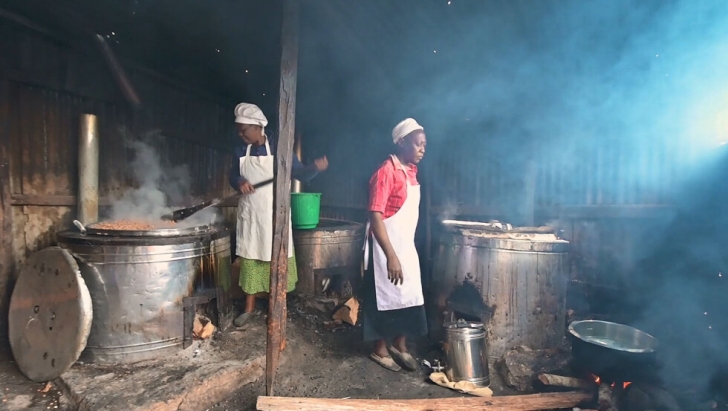
Senior high schools still using firewood and charcoal in their kitchens have been urged to adopt Liquefied Petroleum Gas (LPG) because of health consequences of prolonged exposure to inhalation of smoke from charcoal and firewood.
The call follows disturbing accounts of some kitchen workers in boarding schools who have suffered health complications, including bronchitis and blindness, after years of exposure to smoke from firewood and charcoal.
Speaking at a sensitisation exercise organised by the National Petroleum Authority (NPA), at the Tamale College of Education as part of efforts to promote cleaner cooking alternatives, a lecturer and academic counsellor at the institution's Pre-Vocational Skills Department, Mohammed Mansur Hussein, recounted the tragic case of a woman who worked in a boarding house kitchen and eventually died from bronchitis after prolonged exposure to smoke from cooking with firewood and charcoal.
He said the continued reliance on these traditional fuels in institutional kitchens exposes thousands of kitchen workers and students to avoidable health risks.
He added that another kitchen staff at one of the boarding schools has lost her sight due to cataract, which he attributed to prolonged exposure to smoke in the kitchen. The condition has left her unable to continue working.
These accounts raise serious questions about the conditions under which meals are prepared for students in boarding schools and the extent to which the health and safety of institutional kitchen workers are being protected.
These concerns are further reinforced by a research conducted in the Northern Region by a Senior Lecturer at the Tamale Technical University, Dr Hawawu Hussein.
Her study, which followed more than 1,200 mothers and their babies at four medical centers in Tamale and Savelugu, found that babies whose mothers cooked with charcoal or firewood had approximately four times the odds of suffering coughs and colds compared with babies from households using LPG or electricity.
The researcher explained that fine particles from smoke, resulting from cooking with charcoal and firewood, penetrate deep into the lungs, causing irritation and increasing the risk of respiratory illnesses. Women and children in the study area were found to spend between three and seven hours daily in and around kitchens.
A second study by Dr. Hussein and her colleagues established that pregnant women who cook with charcoal had approximately one-and-a-half times the risk of preterm birth compared with those who used gas or electricity.
The findings provide a compelling public health argument for government to reconsider the continued use of firewood and charcoal in boarding school kitchens, where large quantities of food are prepared daily, often over several hours in enclosed spaces.
Speaking during the sensitisation exercise, the Director of Consumer Services at the NPA, Eunice Budu Nyarko, said the evidence demonstrated that cooks, students and pregnant women bear a disproportionate burden of the health consequences associated with traditional cooking fuels.
She encouraged educational institutions to switch to the use of LPG, describing it as one of the cleanest and most efficient cooking fuels available in the country.
She observed that kitchen workers in boarding houses and halls of residence are particularly vulnerable because of the prolonged hours they spend cooking large quantities of food in enclosed spaces.
She also observed that LPG adoption in northern Ghana remains among the lowest in the country.
Apart from the Tamale College of Education (TATCO), a similar sensitisation exercise was organised the Bagabaga College of Education (BACE), Tamale Technical University (TaTU) and the Dungu Campus of the University for Development Studies (UDS).
In the Upper East Region, the team engaged students and staff of St. John Bosco College of Education and the UDS Navrongo Campus as well as the Midwifery Training College and Bolgatanga Technical University (BTU) in Bolgatanga.
