
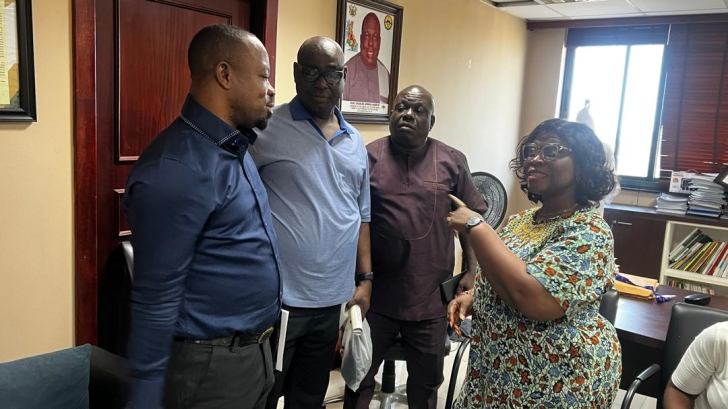
Some members of Parliament's Health Committee have pledged to intensify advocacy for a dedicated malaria budget line to help deal with the issue of malaria elimination across the country.
The MPs dedication followed a closed-door meeting with the Hope for Future Generations (HFFG), a non-governmental organisation dedicated to malaria eradication from the country and other neglected tropical diseases.
The committee members present at the meeting were the Member of Parliament (MP) for Garu, in the Upper East Region, Dr Thomas Winsum Anabah, MP for Pru East, Emmanuel Kwaku Boam, MP for Agotime-Ziope, Charles Akwasi Agbeve and the MP for Central Tongu, Alexander Roosevelt Hottordze.
The MPs expressed concern about troubling gaps in how indoor residual spraying (IRS) contracts were monitored and funded across the country.
The committee members argued that many malaria-related deaths were not the result of an untreatable illness but of delays in reaching health facilities, compounded by poverty and limited public education on early symptoms.
At the heart of the discussion was a call for malaria to be given its own line item in the District Assembly Common Fund or the National Health Insurance Scheme formula, similar to the existing allocation for persons with disability.
The MPs argued that without a ring-fenced allocation, malaria interventions remained scattered across districts and fail to translate into consistent, trackable resources.
The MPs further lamented over the handling of IRS funding, which they said had grown from roughly GHc88 million to GHc250 million cedis in recent budget cycles.
One reencountered how a 2023 site visit by the committee found mosquito breeding grounds still active in areas where contractors had been paid to spray, with residents in some communities saying they had rarely, if ever, seen spraying teams on the ground.
Personal accounts also featured prominently in the meeting where one legislator recalled the death of a constituent's baby from cerebral malaria after a delayed diagnosis, saying the memory continues to affect him and had prompted him to personally fund a GHc20,000 malaria awareness campaign in his constituency.
MPs argued that local ownership of spraying programmes, rather than contracts issued from Accra, would improve accountability saying involving assembly members and traditional authorities directly in scheduling and verifying spraying activity would close the gap between paperwork and what actually happens on the ground, and committed to pushing district assemblies to take greater responsibility for oversight.
The MPs raised concerns about delays between budget approval and actual disbursement, noting that commitment authorisation from the Finance Ministry often stalls at the level of parent ministries before funds can be released for use. Committee members said this bottleneck has left approved programmes starved of cash even after parliamentary sign-off, and called for the process to be simplified.
The meeting closed with a forward-looking commitment: as Ghana prepares its Global Fund grant application for the 2027–2029 cycle, MPs pledged to advocate early for adequate counterpart funding and streamlined processes for procuring malaria commodities, saying early planning would help avoid the funding gaps and last-minute scrambles that have hampered the fight against the disease in recent years.
The Executive Director, HFFG, Cecilia Senoo, said the Global Fund continued support Ghana to support its malaria elimination program under the leadership of MoH and Ghana Health Service.
She called on government to honour its co financing obligations, increase domestic resources for health in general. She applaud the government for investing in the free Primary Health Care for Ghanaians and call for HIV, Tuberculosis and malaria should continue to be part of these packages. She called on the Ministry of Health and the Parliament Health Committee to have an interest in the continuous support of the Global Fund partnership to the country and suggested the appointment of a member unto the funds Country Cordination Mechanism (CCM) so as to help them be abreast of happenings on the fund.
A Programme Manager, HFFG, Gladys Damalie, who briefed the MPs on the work of the organisation said, the HFFG was concerned about domestic resource mobilisation for malaria in the country as the disease continue to remain a top public health priority as it continue to be a leading cause of morbidity and mortality, especially among children under five and pregnant women.
She said although the country had made progress and commended the government on the introduction of free primary health care, she however said to achieve the goal of malaria elimination by 2030, sustained financing is critical.
"Over-reliance on external donors like the Global Fund makes our response vulnerable to funding cuts and shifting donor priorities," she added.
She said the HFFG was looking at creating MPs who will be seen as malaria champions and the organisation was ready to arm them with the needed information to help increase the government of Ghana's allocation to malaria in the 2027 budget to progressively cover 50 per cent of programme costs by 2030.
She called on the MPs to champion malaria as a development issue in their constituencies saying eliminating malaria was not just a health issue, but an economic and development issue.
"With stronger domestic investment and your leadership, Ghana can end malaria and free up resources for other development priorities".
