
African governments have been urged to transform their secondary education systems to prepare the continent’s growing youth population for the changing world of work and expand opportunities for employment, entrepreneurship and lifelong learning.
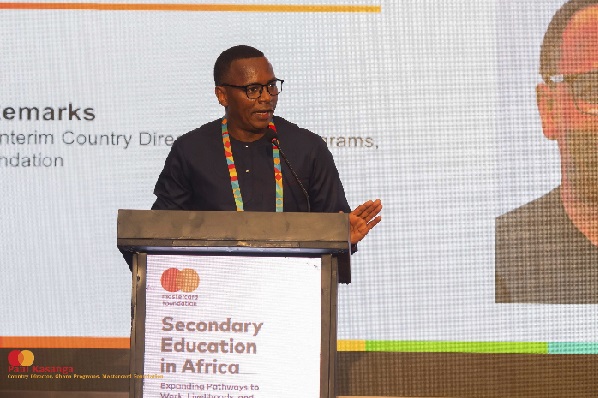
A new report by the Mastercard Foundation, titled “Secondary Education in Africa: Expanding Pathways to Work, Livelihoods, and Lifelong Learning,” calls for a shift from education systems that primarily prepare students for tertiary education to approaches that equip learners with practical knowledge and relevant skills for diverse career pathways.
The report projects that more than 330 million young people in sub-Saharan Africa will reach working age by 2035, presenting a significant challenge for education systems and labour markets across the continent.
It notes that with tertiary education enrolment at just nine per cent, secondary education represents the final stage of formal schooling for most young Africans and offers governments a critical opportunity to prepare the future workforce.
The report was launched in Accra on November 24, 2026, with the participation of education ministers, continental and regional bodies, financial institutions, researchers, teachers and young people.
Enrolment growth
The report indicates that secondary school enrolment across Africa increased from 95 million in 2020 to more than 110 million learners in 2024.
Completion rates have also improved, with lower secondary completion rising from 41 per cent in 2015 to 48 per cent in 2024, while upper secondary completion increased from 30 per cent to 35 per cent over the same period.
It also highlights significant progress in narrowing the gender gap in secondary education.
However, the report cautions that these gains have not resulted in a substantial reduction in the number of young people excluded from education.
An estimated 77 million secondary school-age young people remain out of school across Africa, including 31.2 million in crisis-affected settings.

The report further reveals that 85 per cent of recent enrolment growth is attributable to larger cohorts of young people progressing through the education system, while only 15 per cent reflects improved progression.
It describes this phenomenon as a “demographic treadmill”, explaining that education systems must continually expand simply to maintain existing levels of participation.
Changing employment opportunities
The Foundation argues that secondary education must prepare young people for diverse forms of employment rather than assume that formal employment or university education will be the primary destination for graduates.
The report notes that more than 10 million young people enter Africa’s labour market annually, while only about three million formal jobs are projected to be created each year.
It also highlights the changing nature of employment, with opportunities gradually shifting from agriculture towards services, while artificial intelligence, digital platforms and climate change continue to reshape the world of work.
It recommends that secondary education prepare learners for multiple and often non-linear career pathways, including wage employment, self-employment and entrepreneurship, as well as opportunities in the digital, green, care and creative economies.
The report further reveals that in 2025, young women accounted for 61 per cent of the 102 million young people classified as not in employment, education or training (NEET).
The findings underscore the need for education systems to address barriers that prevent young women and other marginalised groups from accessing education and employment opportunities.
Teacher development
President and Chief Executive Officer of the Mastercard Foundation, Sewit Ahderom, said secondary education must equip young people with the knowledge and skills needed to secure dignified and fulfilling work.
She stressed that teachers played a critical role in translating educational policies and curricula into meaningful learning experiences.
According to her, secondary school represents the last opportunity for formal education systems to reach most young Africans on a large scale.
She called for greater support for teachers and stronger collaboration between governments and development partners to translate the report’s recommendations into practical action.
Ghana’s Minister of Education, Haruna Iddrisu, also identified teacher professional development as a key priority in transforming the country’s education system.
He said although the Free Senior High School (Free SHS) policy had expanded access to secondary education for hundreds of thousands of young people, access alone was insufficient without quality teaching and learning.
He emphasised that building a skilled, motivated and empowered teaching workforce was essential to achieving meaningful educational outcomes.
Liberia’s Minister of Education, Dr Jarso Maley Jallah, also highlighted the need for targeted investment to ensure that more girls and boys remain in school, acquire relevant skills and transition into dignified employment.
Financing remains a major challenge
The report identifies inadequate and unsustainable financing as one of the major obstacles to improving secondary education across Africa.
It indicates that only 22 of the 42 African countries with available data meet the recommended share of gross domestic product allocated to education.
It further reveals that debt servicing has exceeded education spending in 18 countries since 2020.
The report argues that governments must explore sustainable financing arrangements while improving the efficiency of existing resource allocation to enhance access, quality and equity.
Senior Programmes Officer of the Association for the Development of Education in Africa (ADEA), Shem Bodo, described secondary education as critical human-capital infrastructure that requires increased investment and more efficient resource mobilisation.
He said the multiplier effect of investments in secondary education would shape African economies for generations.
Flexible learning pathways needed
The Foundation also recommends that governments recognise and expand flexible learning pathways to create opportunities for young people who cannot access or complete conventional formal education.
Rwanda’s Minister of Education, Joseph Nsengimana, said formal schooling could not be the only route to learning and opportunity.
He called on governments to recognise, accredit and scale alternative learning pathways as an integral part of national education systems.
The report examines several areas requiring attention, including curriculum reform, school-to-work transitions, teacher development, the inclusion of marginalised learners, technology and artificial intelligence, and the financing and governance of education systems.
Its findings are based on a continent-wide study, eight scoping reviews, six thematic background papers and country case studies in Ethiopia, Ghana, Malawi, Rwanda, Senegal, Sierra Leone and Tanzania.
Young people also participated as co-researchers in several of the studies.
Africa’s development agenda
The 2026 report builds on the Foundation’s first Secondary Education in Africa report, published in 2020.
Its recommendations align with the African Union’s Decade of Education and Skills Development (2025–2034), the Continental Education Strategy for Africa 2026–2035, the African Continental TVET Strategy 2025–2034 and Agenda 2063.
The Foundation says the launch will usher in a longer-term programme of country-level engagement, policy dialogue and collaboration with governments and other stakeholders to translate the report’s findings into concrete reforms.
The ultimate objective is to ensure that secondary education equips young Africans not only with academic qualifications but also with the knowledge, skills and opportunities to earn a living and contribute meaningfully to the continent’s development.
