
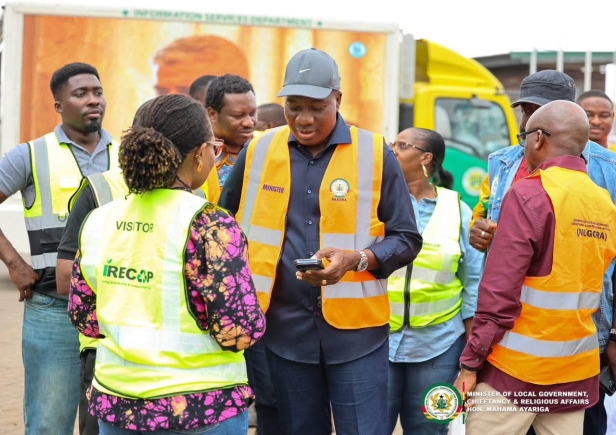
The government is considering a new waste collection system under which households could eventually pay as little as GH¢50 per fortnight, Local Government, Chieftaincy and Religious Affairs Minister Mahama Ayariga has said.
Mr Ayariga said the proposed system, which would involve the establishment of waste transfer stations closer to communities, multiple collection trips and electronic payments, was expected to reduce the cost of waste collection.
He said households currently paying about GH¢300 every fortnight could see their bills fall once the system was fully implemented.
“We can get it down to maybe GH¢100, maybe GH¢50,” Mr Ayariga said during a question-and-answer session at a press briefing in Accra on Monday, October 5, 2026.
The minister clarified that the GH¢50 figure was not an approved tariff, but an illustration of how low household waste collection charges could fall under the proposed system.
Under the plan, waste transfer stations would be located within about five kilometres of the communities they serve.
Mr Ayariga said the shorter distances would allow waste collection operators to make several trips during their working hours instead of spending much of their time travelling to distant disposal sites.
He said waste collection tricycles should operate mainly at night, when traffic was lighter, with the operating period expected to run from about 6 p.m. to 6 a.m.
According to Mr Ayariga, the arrangement would allow operators to make more trips and reduce the cost of transporting waste.
“If you have five trips, you can make five trips in the night,” he said.
The government plans to finance the initial investment in the system, including collection vehicles, tricycles, household waste bins, transfer stations and landfill infrastructure.
Mr Ayariga said part of the investment would be recovered through household waste payments and revenue from waste separated for recycling and waste-to-energy.
An electronic payment system is also being developed to allow households to pay for waste collection digitally.
The system is expected to reduce direct cash transactions between households and waste collection operators.
Mr Ayariga said the government would also monitor waste collection operations electronically, with tracking systems showing where collection vehicles were operating.
The minister said the proposed changes were not intended to push existing waste operators out of the sector.
Rather, he said, the government could provide equipment to operators under a work-and-pay arrangement to enable them to continue providing waste collection services.
Mr Ayariga said smaller tricycles would also remain necessary in communities where larger compactor trucks could not easily operate because of narrow roads.
The proposed system forms part of the government’s wider plan to expand waste management infrastructure across the country.
The plan includes proposals for new landfill sites and transfer stations, as well as the replacement of open-bucket waste collection vehicles.
Mr Ayariga said the government wanted the new system to make waste collection more affordable while improving the movement of refuse from households to transfer stations, treatment facilities and final disposal sites.
He expressed confidence in the proposed reforms and their expected effect on sanitation.
“I am 100 per cent confident that we will win this fight,” Mr Ayariga said.
