
The Ministry of Health is considering using the ongoing review of the Public Health Act, 2012 (Act 851), to introduce measures to eliminate industrially produced trans fatty acids (TFA) from food products on the Ghanaian market.
Dr Hafiz Adam, Director for Technical Coordination at the Ministry of Health, said the option was being considered as a faster alternative to passing a standalone law on trans fats.
He said the existing legislative route involved the Ministry of Health, the Office of the Attorney General, Cabinet and Parliament, making the process lengthy.
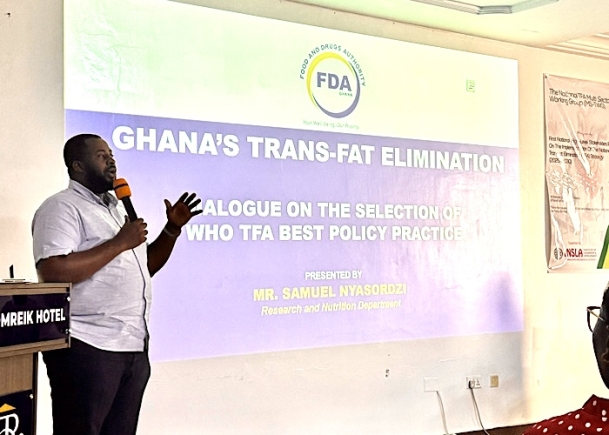
Dr Adam was speaking at the First National High-Level Stakeholders Forum on the Implementation of Ghana’s National Strategy for the Elimination of Trans Fatty Acids in Accra on Friday, October 2, 2026.
The forum, organised by the Institute for Leadership and Development (INSLA), with support from Resolve to Save Lives, was told that about one in 10 packaged food products on the Ghanaian market contained partially hydrogenated oils (PHO), the main source of industrial trans fat.
Dr Adam said discussions were ongoing on whether provisions on TFA could be incorporated into the review of the Public Health Act to shorten the legislative process.
He said the review of the Act had to be concluded to provide the legal basis for the measures, adding that the Act already established the Food and Drugs Authority (FDA), which is responsible for regulating food products and overseeing compliance.
Dr Adam said Ghana had often been strong in developing policy documents but faced challenges in translating them into action.
He said the value of the national strategy would depend on its translation into regulations and measurable results.
The National Strategy for the Elimination of Trans Fatty Acids covers the period 2025 to 2030.
Mr Benjamin Anabila, Director of INSLA, said the strategy was launched on October 24, 2025.
Dr Adam said the strategy had three objectives: reducing the public health impact of trans fat, securing sustainable financing, and strengthening monitoring and enforcement.
It is expected to cost about GH¢11 million and assigns responsibilities to government institutions, regulators, industry, academia and civil society.
Dr Adam identified the absence of legislation, weak data, limited laboratory and enforcement capacity, unpredictable funding and poor coordination among institutions as some of the challenges to implementing the strategy.
On data, he said non communicable disease mortality had been quoted variously between 43 and 46 per cent in documents he had seen, which he said undermined credibility.
He also referred to reduced external funding without naming any donor.
Dr Adam said the FDA and INSLA had participated in studies of refined cooking oils and packaged foods, with the findings expected to inform regulatory decisions.
He said the Ministry was also developing a policy that would require manufacturers to declare the quantities of ingredients in food products.
Dr Adam said he had held meetings with representatives of the food industry, during which small and medium sized enterprises raised concerns about possible job losses.
He said the Ministry was not asking producers to stop operating but to innovate, and suggested that tax exemptions could be considered for producers that introduced innovative products.
The World Health Organisation (WHO) says 53 countries had best practice policies in effect at the end of 2023, with Egypt and Nigeria among seven countries whose policies became effective that year.
Dr Adam said the WHO recommended either a mandatory limit of two grammes of industrially produced trans fat per 100 grammes of total fat or a ban on PHO as an ingredient.
He urged participants to agree on a regulatory approach and a timeline, improve the available data, strengthen laboratory capacity and identify sustainable sources of funding.
Ms Alissa Pries of Resolve to Save Lives presented findings from two studies on trans fat in cooking oils and packaged foods.
The first study, which formed part of an 11 country study, examined refined cooking oils at eight vendor sites in Accra and identified 51 different oils.
Eleven of the oils were tested at a laboratory in Portugal and none exceeded the two grammes per 100 grammes limit.
Only three of the 51 oils were made in Ghana, while the rest came from countries including Spain, Lebanon and the United Kingdom.
Palm oil was not tested because it does not typically contain industrial trans fat.
The second study screened more than 1,600 different products recorded in the Mintel database between 2023 and 2025. About 10 per cent, or 165 products, contained PHO.
Bakery products were the worst affected, with 34 per cent containing PHO, while almost a third of desserts, ice creams and chocolate confectionery products also contained PHO.
More than a third of the products containing PHO were made in Ghana, while just over half were imported.
Ms Pries said manufacturers often described PHO using terms such as “vegetable fat”, “margarine” and “shortening”.
Only 24 per cent of the products containing PHO declared their TFA content, while almost one in five carried a nutrition or health claim. Some were labelled “TFA free”.
She said several countries from which the products originated had introduced their own TFA policies, creating the possibility of products being redirected to markets without such measures.
Ms Pries cautioned that the oil study covered only Accra and involved a small sample.
She said mandatory measures worked best and that a PHO ban was easier to enforce because ingredient lists could be screened before laboratory testing.
Prof. Amos Laar of the University of Ghana School of Public Health presented the Ghana Double Duty Nutrient Profiling System, developed by the FDA and the Ministry of Health with academic support.
The system draws on composition data for 6,400 foods, reduced from an initial database of about 10,000.
It scores foods from one to 10. Foods scoring below three are discouraged, those scoring from three to 6.9 are for moderate consumption, while those scoring seven and above are promoted.
Prof. Laar said the system could be used to support front of pack warnings, marketing restrictions, taxes and public food procurement rules.
He said PHO should be banned rather than taxed or merely restricted.
The WHO attributes more than 278,000 deaths a year to industrially produced trans fat and says it has no known health benefits.
Prof. Laar said more than half of the 6,400 foods did not declare their TFA content.
“If it is not declared, we will not be able to enforce,” he said.
He also noted that half of women aged 20 to 49 were overweight or obese, according to the 2022 Ghana Demographic and Health Survey.
Mr Anabila said the project began around 2020 or 2021 with a stakeholder consultation.
The consultation led to the formation of a multi sectoral technical working group comprising health, regulatory, customs, standards, education, research and academic institutions. The group was chaired by Dr Felix of the School of Public Health.
The group’s situational analysis was submitted to the Ministry, which subsequently developed the strategy.
Mr Anabila said Ghana lacked the capacity to test for TFA, resulting in oil samples being shipped abroad by INSLA and the FDA. The results were subsequently submitted to the FDA.
He described the forum as the second phase of the project, with full implementation targeted for 2030.
The chairperson of the forum, Dr Phyllis Addo, urged INSLA to take note of the option of using the Public Health Act review to introduce measures on TFA.
Participants later voted on the preferred policy approach and reached consensus on both the two grammes per 100 grammes limit and a ban on PHO. They also developed an implementation roadmap.
