
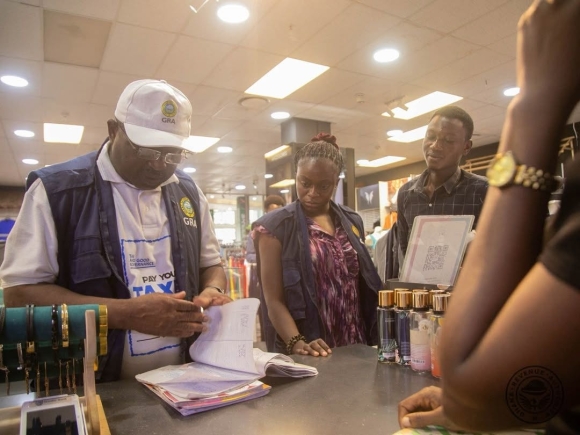
The Ghana Revenue Authority (GRA) has arrested operators of three China Mall branches at Ashaiman, Weija and Nsawam for allegedly evading tax through its Electronic Value Added Tax (E-VAT) system.
The arrests followed the intensification of enforcement operations by the authority in the Greater Accra Region last Friday, November 13, 2026, at the three China Mall branches: the West Hills Mall at Weija and the Achimota Retail Centre.
The enforcement teams, led by the Accra Central Area Enforcement Manager, Joseph Adjekwei Annan, and the Head of the GRA’s Revenue Protection Unit, Wisdom Kofi Xetor, uncovered several infractions. These included attempts by businesses to divert sales transactions from the GRA-approved electronic invoicing platform to independent systems, the use of unauthorised sales systems, suspected tax evasion, and shops operating without dispensation.
Authorisation infractions
At the Achimota Retail Centre, for instance, the authority found that Carrefour Ghana had been transacting business as Shoprite even though management had changed. The shop was also found to be operating without dispensation from the GRA.
Shops such as Divine Jeskev Limited, Scentopia, DOH, Euro Outfits, The Chop Bar, and Spendstre Ghana Limited were also cited for using their own computers to generate invoices without authorisation. Bijou Ghana Limited was found to be charging a flat VAT rate, while Maxbuy was faulted for issuing its own invoices.
Still at the Achimota Retail Centre, First Choice Hair and Beauty and MV Company Limited were cited for not issuing VAT receipts, while Benmorr Ghana Limited had no branch certificate but was found to be operating on E-VAT. Art Kitchen also generated its own invoices without authorisation and had no branch certificates.
The GRA subsequently confiscated their system units and issued notices to the defaulting shop owners to report to GRA offices for further audits.
Compliance very low
Addressing the media after the exercise, Mr Annan said the authority was back on the field to send a strong signal to the trading public.
"Compliance is very low. Anyone who needs assistance should come to us, but do not wait for us to come to you before you do the needful," he emphasised, urging the public to insist on their VAT receipts.
"When you buy, demand the invoice. It is very, very important that you demand it anywhere you buy. That is the only way we know how much we are getting from VAT. Once you are buying, you must have evidence of payment,” he added.
Mr Annan noted that for businesses registered for VAT, issuing the invoice was not enough. He stressed that shops must declare and pay immediately.
"We have a lot of those who declare, but they do not pay. Let me let you know that when we find you out, do not come and plead. Once you declare, payment is immediate," he said, adding that shops using unauthorised computers to generate invoices could cause serious tax leakage.
He explained that businesses could not simply buy machines and start generating VAT invoices; they must formally write to the authority for authorisation and meet specific requirements, including having systems capable of storing data for several years for auditor retrieval.
Mr Annan stated that the current exercise, which included invoice inspections, test purchases and mystery shopping, would not be a one-off campaign. He urged businesses to voluntarily regularise their operations before enforcement officers arrived, to spare them the payment of interest and penalties.
Diverting transactions
The Head of the GRA's Revenue Protection Unit, Wisdom Kofi Xetor, said preliminary investigations had established that the businesses had installed independent platforms to divert some transactions from the approved system. He noted that this arrangement was intended to suppress sales figures and underreport tax obligations.
Mr Xetor explained that the GRA's approved platform was connected to businesses' sales devices, allowing transactions to be transmitted directly to the authority for monitoring. However, he said some businesses allegedly installed separate systems, meaning transactions processed through those platforms were not captured by the GRA.
He illustrated the practice with a business operating 10 sales machines, seven of which were allegedly connected to an independent platform, while only three were linked to the GRA-approved system. He noted that the authority was yet to establish the total amount of tax involved, adding that further investigations would determine the value of undeclared sales and the corresponding tax obligations.
Prosecution
Mr Xetor said the authority intended to hand over the arrested operators to the police to assist with investigations and facilitate their prosecution. He stated that the GRA would push for custodial sentences where deliberate tax evasion was established, to serve as a deterrent to other businesses.
He added that the authority would also investigate the circumstances surrounding the installation and use of the independent sales platforms, warning businesses registered for VAT, particularly those already onboarded onto the E-VAT system, against circumventing the approved platform.
