
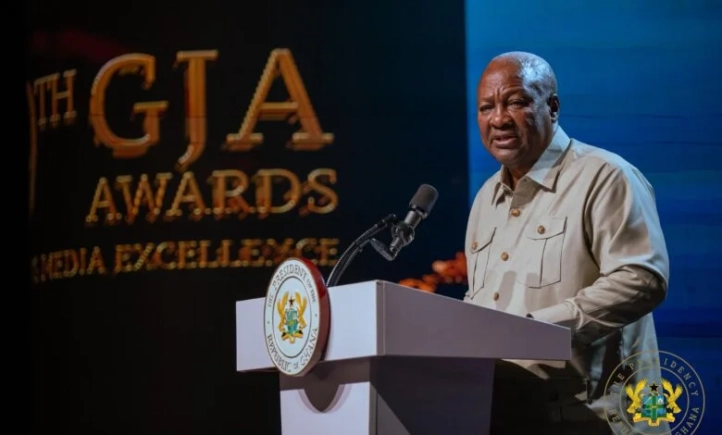
President John Dramani Mahama has announced a GH¢10 million allocation in the 2027 national budget as seed money for the Media Development Fund to support journalists' welfare, training and professional development.
He made the announcement at the 30th Ghana Journalists Association Media Awards in Accra on Saturday, November 7, 2026.
The ceremony, chaired by the Ga Mantse, King Tackie Teiko Tsuru II, was held under the theme "Celebrating Excellence, Advancing Media Freedom, and Combating Hate Speech in the Digital Age."
The 2027 Budget Statement is expected to be presented to Parliament on Thursday, November 12, 2026.
President Mahama said the fund would support journalists' welfare, professional development, investigative reporting, digital literacy and safety training.
He recalled that he announced plans to reactivate the fund at the 29th GJA Media Awards. "I shall personally work with the GJA to get several other corporate institutions to contribute to the fund," he said. He specifically appealed to KGL and the Bank of Ghana to contribute. "So KGL, Bank of Ghana, all of you, we're coming to you to contribute to the media fund," he said.
President Mahama said the government would work with the GJA and other stakeholders to provide practical support for journalists while respecting editorial independence.
On the safety of journalists, he said media practitioners must be allowed to investigate and publish stories without censorship, intimidation or undue interference. He said threats, assaults and attempts to obstruct journalists in the performance of their duties must be investigated promptly and impartially.
The President expressed concern about the conduct of some security personnel, whom he accused of harassing media practitioners in their attempt to project authority. He said he had discussed the matter with the leadership of the GJA and commanders of the various security agencies. "We'll continue to take action whenever a media person is unfairly assaulted while performing their duties," he said.
President Mahama also paid tribute to the late investigative journalist, Ahmed Hussein-Suale, whose killing he said remained a painful reminder of the dangers journalists faced in pursuing investigative stories. "His family deserves justice," he said.
He welcomed Ghana's improvement in the 2026 World Press Freedom Index published by Reporters Without Borders, moving from 52nd to 39th position among 180 countries. He pledged to work with the GJA to maintain an environment in which journalists could perform their duties without fear.
Touching on the growing influence of digital platforms, President Mahama warned that false information could spread to thousands, and even millions, of people before the facts were established.
He cited a video showing people in Liberia exposing poor road construction, which was later circulated in Ghana with an altered voice-over to suggest that the incident had occurred in the country. He also expressed concern about the use of artificial intelligence to create fake images and recordings, including fraudulent investment promotions in which he was falsely portrayed as endorsing investment schemes. He said some people had contacted him to establish whether the recordings were genuine.
President Mahama said he had tasked the Media Foundation for West Africa and the GJA to undertake consultations and make recommendations on how to manage the changing media environment. "We must as a society agree on where we draw the line between free speech, hate speech, and outright insults," he said. He added that any action taken in response to credible threats or incitement to violence must be lawful, proportionate and subject to due process.
The President urged editors to give greater attention to issues affecting ordinary people rather than concentrating largely on daily political exchanges. He cited farmers who lost their produce because of poor road access during the rainy season, mothers who travelled long distances to access healthcare and young people who struggled to find jobs after completing their apprenticeships. He said morning radio discussions involving representatives of political parties on subjects "ranging from animal science to nuclear power" might entertain audiences but did little to educate the public.
President Mahama also urged journalists and media houses to retract inaccurate reports or apologise when their publications wrongly damaged the reputations of individuals or institutions.
He said many media houses found it difficult to admit their mistakes and apologise to people affected by inaccurate reports. He further encouraged experienced editors to create opportunities for younger reporters to learn and develop their journalistic skills.
The President also criticised what he described as excessive media zealotry, particularly instances in which journalists publicly challenged ministers to call into their programmes to answer questions about alleged discrepancies.
He said although the government respected the media's responsibility to hold public officials accountable, deliberately searching for scandals where none existed distracted attention from the country's development agenda.
President Mahama urged public officials to respond to difficult questions with the same openness they demonstrated when announcing their achievements. "We will uphold your right to exercise your mandate, even when you ask us the most difficult questions," he said.
