
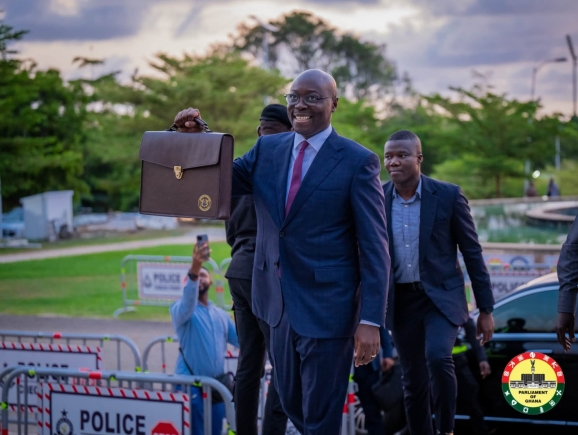
The government plans to require public institutions to buy uniforms, hospital bedding, textiles and protective clothing from local manufacturers as part of efforts to expand the market for Ghana-made products.
The proposed policy, announced by the Finance Minister, Dr Cassiel Ato Forson, forms part of the government's plans to strengthen the textile and garment manufacturing industry and reduce reliance on imported products.
Presenting the 2027 Budget Statement and Economic Policy to Parliament on Thursday, November 12, 2026, Dr Forson said the government would amend public procurement laws to give preference to locally manufactured products.
Under the proposal, public institutions would be required to use public funds to purchase uniforms, hospital textiles, bedding and protective clothing for security agencies from Ghanaian textile and garment manufacturers.
The measure forms part of a US$1 billion investment programme for the textile and garment industry under the government's four-year New Economy initiative.
The proposed procurement changes are expected to create a reliable market for local manufacturers, encourage the expansion of factories and create employment opportunities, particularly for women and young people.
The announcement builds on earlier government measures to promote the production and use of locally manufactured goods.
In April 2025, Dr Forson announced plans to introduce a list of locally manufactured products which public institutions would be required to purchase from domestic producers.
In July 2025, the Ministry of Trade, Agribusiness and Industry also engaged state institutions on strategies to promote the local production of uniforms.
The International Labour Organisation (ILO) reported in March 2026 that the government had reaffirmed its intention to prioritise locally manufactured garments in public procurement under the Dress Ghana and Build Ghana campaign.
President John Dramani Mahama also announced in August 2026 that the government was working to amend the Public Procurement Act to give preference to licensed Ghanaian-made products.
He specifically mentioned uniforms for the military, police, prisons and immigration services.
The latest budget announcement extends the proposed procurement requirements to hospital textiles and bedding.
US$1bn investment in textile industry
Beyond the proposed changes to public procurement, the government plans to invest US$1 billion in modernising textile mills, expanding garment factories and developing industrial zones.
The planned industrial facilities will have serviced land, reliable electricity, industrial water, laboratories, warehouses and factory buildings to support production.
The government also intends to support fashion designers, tailors and dressmakers with modern equipment, technical assistance and business partnerships to improve their access to local and international markets.
Infrastructure development and the modernisation of selected facilities are expected to begin in 2027, while new and upgraded production lines are expected to become operational in 2028.
By 2030, the government aims to establish a textile and garment industry capable of producing on a commercial scale and supplying regional and international markets.
