
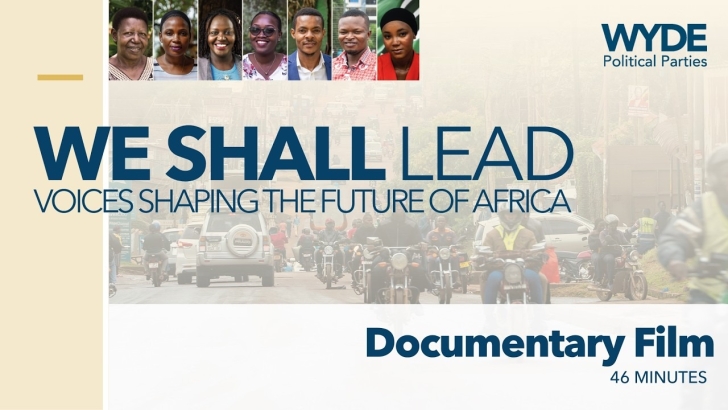
Three Ghanaian youth leaders have called for a greater role for young people in political decision-making, stating that more young Ghanaians would enter politics if they saw their peers being heard on matters affecting them and their communities.
They are the President of the Ghana Youth Federation and Chief Executive Officer of the Ghana Chamber of Young Entrepreneurs, Sherif Ghali; the Vice-President of the Students’ Representative Council of the Ghana School of Law, Hariratah Ibrahim Doudu; and the President of the National Union of Ghana Students, Rashid Ibrahim.
They made the call in We Shall Lead: Voices Shaping the Future of Africa, a 2026 documentary filmed in Ghana, Kenya and Uganda under the European Union’s Women and Youth Democratic Engagement (WYDE) Political Parties project. It features seven individuals who have sought to bring about change through student leadership, community work and political parties.
The documentary was developed to give greater prominence to the voices of women and young people working for democratic change. It examines why people choose to enter politics and what it takes to pursue change from within political institutions.
Decision-making
Mr Ghali said the experience of young people who had entered politics only to find that their views carried little weight had discouraged others from following them.
“You go into politics, and still your voices are not heard. And I always say that it’s not about including us, it’s about allowing us to take decisions,” he said.
Mr Ghali also questioned the belief that people had to reach a certain age before they could lead. He said younger people could assume leadership responsibilities and still uphold the tradition of listening to their elders.
Women’s representation
Ms Doudu said that when she decided to contest the student vice-presidency at the Ghana School of Law, she learnt that no woman had sought the position in about five years, although women outnumbered men on her campus.
She traced her resilience to growing up with about 24 siblings. Shortly before she completed senior high school, her father, the family’s breadwinner, died. Facing her final examination, she said she kept telling herself, “Focus on your exam, pass, help will come.”
At the law school, a conversation about the difficulties students faced prompted a colleague to invite her to join his campaign. She called him that night to accept. When she won, she wept.
“I was crying because I had proven to myself that I’m capable, that I’m competent, indeed I’m going to help create change,” Ms Doudu said.
Community concerns
Mr Ibrahim said he had sought student leadership because people in the farming community where he grew up in the Nkoranza South Municipality struggled to get a hearing from those in authority. His parents were peasant farmers in the community of about 500 residents.
“So I actually wanted to be the voice for the voiceless in my community. When they speak, no one listens,” he said.
Mr Ibrahim said the NUGS presidency had given him an opportunity to bring those concerns to the attention of leaders. He urged young people aspiring to office to gain experience in the fields in which they hoped to serve and called on those already in authority to give them the opportunity to lead.
He also called for support for young Africans who had set up their own businesses, describing unemployment as “the biggest disease on the African continent”.
The documentary brings together voices from Kenya, Uganda and Ghana to explore why people still choose politics and what it means to pursue change from within political institutions. It features seven people from different generations who have taken different paths into politics, including community leadership, student politics and formal party structures.
