

The government is strengthening its collaboration with the Student Workforce and Innovation Movement (SWIM) to address the gap between education and employment and create opportunities for young people.
SWIM is a youth-focused global initiative that connects students to skills training, digital learning, professional networks and paid work opportunities under the principle of 'Learn, Earn, Launch'.
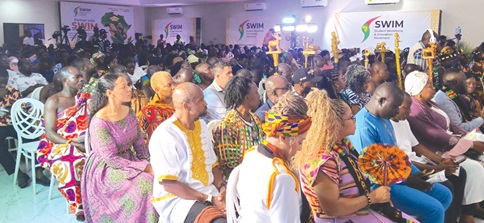
The Minister of Youth Development and Empowerment, George Opare-Addo, announced this at the global launch of SWIM at the Lombardo Event Centre at Breman Asikuma in the Central Region.
He said the collaboration was intended to establish practical pathways for young people to transition from education into employment and entrepreneurship.
He disclosed that the National Entrepreneurship and Innovation Programme (NEIP) had signed a Memorandum of Understanding (MoU) with SWIM to support youth skills development, entrepreneurship and employment opportunities.
Mr Opare-Addo said a major challenge confronting the country was not simply the number of graduates produced by educational institutions but the difficulty of connecting their knowledge and skills to available economic opportunities.
Many graduates, he observed, completed their education without clear employment pathways, while others with promising business ideas lacked the mentorship, networks, technical assistance and financial support needed to establish viable enterprises.
Research
Citing research conducted by the ministry, he said graduates who undertook their national service in government institutions took an average of four to 10 years to secure decent employment, compared with two to three years for those who served in the private sector.
He urged universities and other educational institutions to strengthen their relationships with industry to complement academic training with practical workplace experience.
He said the government was implementing initiatives, including the Adwumawura Programme, through NEIP to support at least 10,000 young entrepreneurs annually over four years through training, business development assistance and grants to selected viable businesses.
He also mentioned the Student Entrepreneurship and Enterprise Development Programme (SEED), which seeks to help tertiary students and graduates transform business ideas into viable and scalable enterprises.
Inequalities
The Chief Executive Officer of SWIM, Louv Afua Amoakowaa Ford, said the initiative was established to address inequalities in access to educational and professional opportunities, particularly among young Africans.
She said more than 8,000 students had registered on the platform, which also provided virtual learning spaces for international collaboration, mentorship and professional networking.
The Chief Global Strategy Officer of SWIM, Dr Tanya Wiley-Brown, said the organisation was collaborating with partners, including MTN Ghana, to address internet connectivity barriers through student data bundles and expand access to training in artificial intelligence and emerging technologies.
She appealed to corporate institutions, governments and development partners to support the initiative through sponsorship, certification, funding and paid work opportunities.
The Omanhene of the Breman Asikuma Traditional Area, Odeefuo Amoakwa Buadu VIII, welcomed the initiative, saying many families made significant sacrifices to educate their children, only for them to graduate into unemployment.
