
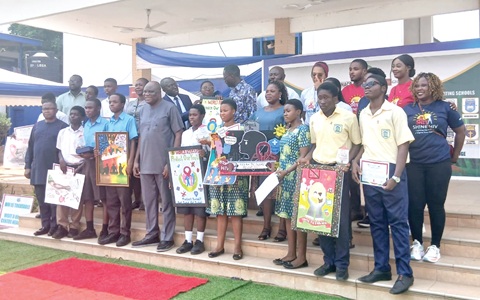
The Ghana AIDS Commission (GAC) has urged young people to ask questions, express their views, challenge harmful beliefs and become ambassadors of accurate HIV information in their schools, families and communities.
It said the voices, ideas, creativity and influence of young people were essential if the country were to achieve its goal of ending AIDS as a public health threat by 2030.
The Director of Research, Monitoring and Evaluation of the commission, Isaiah Doe Kwao, who said this last Tuesday at the World AIDS Day Inter-Schools Art Challenge and Debate Competition for senior high schools (SHSs), said protecting young people went beyond preventing new infections, adding that it meant creating an environment where people were treated with dignity, where stigma and discrimination had no space and where people living with HIV (PLWHIV) could access the support and services they needed without fear of rejection and judgement.
The art challenge and debate competition are to offer the students the platform to demonstrate their knowledge and understanding of HIV and AIDS and related issues, as well as their ability to think critically, express themselves confidently and use their talents to influence positive change.
Mr Kwao said as Ghana commemorated 40 years of its HIV response, all concerned individuals needed to renew their commitment to ensure that no young person was left behind in the country’s efforts to prevent new infections, eliminate stigma and discrimination and build a healthier nation where an informed generation did not indulge in any risky behaviour.
On the debate and art challenge, he said it was about learning, building confidence and recognising the role each of the students could play in protecting the next generation.
Commenting on the strategic shift in the commemoration of this year’s World AIDS Day, the Deputy Director of Programmes, GAC, Derick Oppong-Agyare, said with 27.5 per cent of new HIV infections occurring in the 15 to 24 age bracket in 2025, and with the low level of comprehensive knowledge about HIV and AIDS in both males and females, the commission decided to directly engage the youth with a quiz, debate and art challenge to impart relevant knowledge.
Speaking on behalf of the Greater Accra Regional Director of Education, the Regional Coordinator of School Health Education Programmes, Philipina Tuffour, told the students they were living in an era where HIV and AIDS were very prevalent in schools in the country and in their communities.
She urged them to be ambassadors in their schools, homes and communities of HIV and also desist from stigmatising PLWHIV.
The art challenge, which was on the theme: “Protect our Youth”, saw Accra Academy, Labone SHS, which was the host school; Accra Girls SHS, West Africa SHS (WASS), Accra High School and St Thomas Aquinas SHS, exhibit and explain the beautiful artworks on the theme that they had come out with.
In the end, Accra Girls SHS emerged as the winner, followed by St Thomas Aquinas SHS and Accra Academy in the second and third positions, respectively. WASS, Accra High and Labone SHS took the fourth, fifth and sixth positions in that order.
The debate, which was on the motion, “Preventing pregnancy is not the same as preventing HIV and AIDS”, was between Kwabenya Community SHS, which emerged as winner and St John’s Grammar.
