
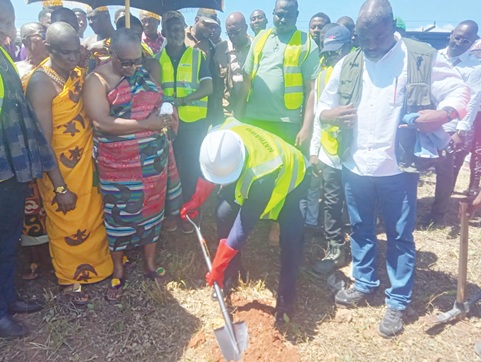
Work has started on the development of two inland valley projects - water conservation schemes- in two communities in the Ashanti Region.
The beneficiary communities are Anunuso near Brofoyedu in the Sekyere East District and Waamu-Kumi near Barekese in the Atwima Nwabiagya North District.
They are expected to be completed in 18 months.
When completed, both projects would add a total of 289 hectares to the nation’s stock of irrigable land, which would benefit at least 365 farmers in the two communities and adjoining areas.
The projects form part of the development of selected inland valleys under a West Africa Food System Resilience Programme (FSRP), through an ‘Irrigation for Wealth’ module of the Feed Ghana Programme of the government.
Also, it is intended to guarantee year-round agricultural production, reduce perennial food shortages and price volatility that threaten market stability.
Under the programme, some 4,800 hectares, made up of 3,700 hectares across four irrigation systems and 1,100 hectares across inland valley enclaves, would be rehabilitated.
The irrigation schemes are Kpong, Tanoso, Vea and Weta, while the inland valleys include Anunuso, Odaho/Odamu, Waamu-Kumi and Kawampe.
At separate sod-cutting events last Friday, the Minister of Food and Agriculture, Eric Opoku, said the intervention was an important step towards improving the conditions under which farmers produced food and earned livelihoods.
“For the farming communities around the valleys, the value of this investment will be measured in reliable access to water, better harvests and more dependable outcomes,” he said, adding that “improving water management is, therefore, an investment towards stabilising rural livelihoods”.
The minister said the Feed Ghana Programme gave attention to irrigation and water conservation through its irrigation for wealth module for the growth of the agricultural sector.
“Our purpose is to help farmers make better use of productive land, reduce their exposure to unreliable rainfall and expand opportunities for production across the year. Water infrastructure must be accompanied by the services that enable farmers to use it profitably,” he said.
The minister further said that once the schemes became operational, their care must be a shared responsibility, water distributed fairly, maintenance addressed early, while agreed arrangements for meeting routine costs must be transparent.
Deployment
The Project Coordinator, FSRP, Nathaniel Adams, said the project was deploying a combination of adaptive, innovative, and sustainable interventions designed to equip vulnerable households, farming communities, and commercial agricultural enterprises to withstand production, post-harvest, and marketing challenges.
He said the project had prioritised the intensification of production, processing, marketing, consumption and waste recycling of five critical commodities - rice, tomatoes, broiler poultry, maize and soybeans.
“FSRP is implementing a commercial poultry broiler initiative aimed at improving the competitiveness of the local industry through the use of improved production, processing and packaging methods, coupled with aggressive marketing to meet the local consumptive patterns,” the coordinator added.
Appreciation
The Secretary of Ndoboa Farmers’ Cooperative and Marketing Society, Prince Ampatey, lauded the intervention and said it would help farmers reduce post-harvest losses.
The Chief of Amakye Bare, Nana Gyedu Kumanin IV, expressed gratitude to the government for the project, describing it as an important intervention that would contribute to food production in the area.
For his part, the District Chief Executive of Sekyere East, Ibrahim Adams, said there was a need for a rice processing centre and harvesters to enhance rice production in the district.
