
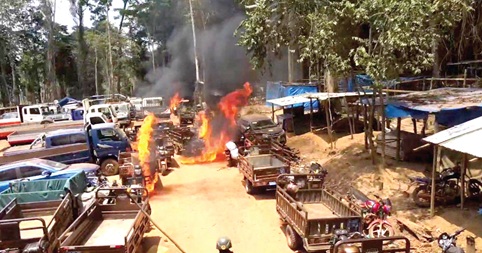
The Western Regional Minister, Joseph Nelson, has called for a coordinated approach by the Forestry Commission, the National Anti-Illegal Mining Operations Secretariat (NAIMOS) and other relevant state agencies to strengthen the fight against illegal mining.
He expressed concern that the Forestry Commission and other institutions were addressing the same problem independently, despite being under the same ministry, warning that working in silos would undermine efforts to tackle the menace.
He stressed the need for the relevant state institutions to work together to close gaps in their operations and eliminate areas identified as red zones because of illegal mining.
“This fight is one that has to be collective.
The Forestry Commission is doing something on its own on the same challenge we have. What is the collaboration like, or who is collaborating with who?” he asked.
Work together
Speaking after the Forestry Commission discovered another serious invasion of the Subri River Forest Reserve in the Western Region, Mr Nelson expressed concern about the lack of coordination among institutions dealing with the problem.
He said the region was committed to eliminating areas identified as red zones because of illegal mining, and was determined to end the illegal activities, stressing the need for a coordinated effort involving all relevant stakeholders.
Armed security camps
The Western Regional Manager of the Forestry Commission, Nana Poku Bosompim, said the commission was piloting a new security strategy to protect the Subri River Forest Reserve from illegal mining.
He said the Commission as part of the strategy, planned to setup armed security camps and modern surveillance technology while strengthening collaboration between state security agencies.
The strategy is aimed at preventing illegal miners from returning to areas cleared during enforcement operations. Mr Bosompim said the Subri River Forest Reserve spanned more than 58,000 hectares, making it the country’s largest forest reserve and one of the Western Region’s most important ecological assets.
The reserve accounts for about 30 per cent of the region’s total forest reserves, making illegal entry and destruction a threat to human existence by the activities of the more than 1,000 armed illegal miners reportedly operating in the area.
Repeated enforcement
Mr Bosompim said the commission was piloting a forest security camp system under which teams of about 13 armed rapid-response officers would be stationed at cleared mining hotspots to prevent illegal miners from returning.
The camps will be supported by motorbikes, vehicles, CCTV cameras and powered by satellite internet connectivity to monitor activities and facilitate rapid reinforcement when threats arise.
Already, the officers have undergone specialised training for operations in forest terrain and the Commission’s enforcement efforts across the region have yielded some results, including the destruction of illegal mining equipment, arrests and prosecutions.
The affected area of degraded forestland, Mr Bosompim said, had declined from about 680 hectares to 282 hectares, representing a reduction of nearly 60 per cent.
He, however, said the gains remained fragile because illegal miners often returned to previously cleared areas after enforcement teams moved to other forest reserves.
Mr Bosompim said the Western Region had 19 forest reserves covering approximately 209,333 hectares, making it difficult to maintain a continuous security presence across all affected locations.
The region's forest reserves, he said, were spread across Tarkwa, Asankragua and Juaboso, and emphasised that the region was home to the country's only wet evergreen forest, the Ankasa Conservation Area.
Seven forest reserves affected
The regional manager disclosed that seven of the 19 reserves had been directly affected by illegal mining, with an estimated 1,533 hectares of forestland destroyed.
He said some mining activities were conducted beneath the forest canopy, making the extent of destruction difficult to detect from above.
“Some of the mining activities are done under the canopy, at a standard distance one will see nothing; the forest appears intact.
But when you go underneath, that is when you see trenches and the true scale of destruction is often hidden by the forest cover,” Mr Bosompim explained.
