
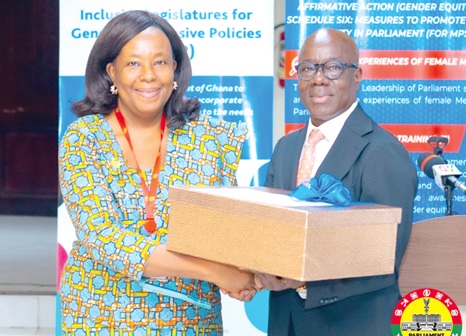
The Speaker of Parliament, Alban Sumana Kingsford Bagbin, has said that the House will integrate outcomes of the Inclusive Legislatures for Gender Responsive Policies (ILGRP) project into its legislative, oversight and budgeting processes to sustain gains in gender equality and inclusive governance.
The project’s success, he said, would depend on integrating its knowledge, tools and resources into parliamentary practices to promote gender-responsive legislation, strengthen accountability and deepen engagement with women, girls and civil society.
“As we bring the formal phase of the ILGRP to a close, Parliament recognises that the true measures of the project’s success will lie not simply in activities completed or resources produced and handed over to us today, but in how these resources are used to improve parliamentary practice,” the Speaker said.
The Special Advisor to the Speaker on Gender and Health Matters, Dr Silvia Ani, read Mr Bagbin’s speech on his behalf at the close of the ILGRP project in Parliament yesterday.
The four-year project supported the Parliaments of Ghana, Togo and Kenya to strengthen gender-responsive governance, promote women’s participation in democratic processes and ensure that legislation and public budgets reflected the diverse needs of citizens.
It also sought to strengthen parliamentary oversight of government commitments to gender equality, including promoting transparent and inclusive governance.
Implemented in collaboration with the Parliamentary Centre of Canada, the African Centre for Parliamentary Affairs (ACEPA), and technical experts, the project was supported by the Government of Canada.
In all, 19 documents or working tools that emanated from the project were presented to the Speaker to serve as a guide.
Institutional ownership
Mr Bagbin said the completion of the ILGRP project’s formal phase marked the beginning of sustained efforts to strengthen gender-responsive governance.
He said the project’s success would be measured by its practical impact on parliamentary work, rather than the number of activities completed or resources handed over.
Mr Bagbin stressed the need for MPs and parliamentary staff to apply the project’s resources in their work, saying they must “not remain on shelves but become practical instruments of parliamentary work”.
He said applying the project’s outcomes would strengthen gender-responsive legislation and budgeting, improve oversight of gender equality commitments and deepen engagement with women, girls and civil society organisations.
Mr Bagbin acknowledged the contribution of the Government of Canada and its development agency, Global Affairs Canada, to strengthening parliamentary democracy in Ghana over the years.
He said the partnership had evolved from the era of the Canadian International Development Agency (CIDA) to the present engagement through Global Affairs Canada, supporting initiatives aimed at enhancing legislative capacity, institutional development, accountability and democratic governance.
Institutionalisation
The ACEPA Executive Director, Dr Rasheed Draman, urged Parliament to institutionalise gender considerations in its legislative, oversight, budgeting and administrative processes to sustain the gains of the ILGRP project.
He said the project’s completion should usher in sustained inclusive governance, stressing that “gender responsiveness must move from being a project objective to becoming an institutional habit.”
“The policies, tools, knowledge and capacities developed through ILGRP must find a permanent home within the systems of Parliament,” Dr Draman said, adding that lasting institutional changes required leadership, accountability and consistent practice.
In an address read on her behalf, the Head of Cooperation and Chargé d’Affaires at the High Commission of Canada, Francoise Nduwimana, said the historic achievements of the project demonstrated how strengthened institutional capacity could translate into meaningful legislative outcomes.
