
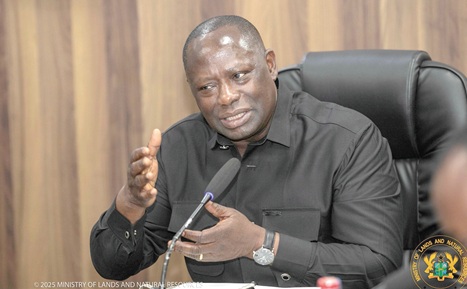
The government has said it is determined to end the exportation of raw materials by 2028, as part of efforts to accelerate domestic mineral processing to retain more value from the country's natural resources.
The Minister of Lands and Natural Resources, Emmanuel Armah-Kofi Buah, said the government intended to refine at least 70 per cent of artisanal and small-scale gold locally by December 2027, and increase it to 100 per cent by December 2028.
He said the government was targeting local processing of at least 50 per cent of manganese and bauxite production by 2028, with the aim of processing all by 2030.
“The era of exporting our minerals in raw form must give way to one in which we refine, process and manufacture our minerals at home.
“We are determined to ensure that the refinery, the smelter and the steel plants are all built in the country,” Mr Buah added.
Speaking at an Industrialisation Day celebration organised by the Trades Union Congress (TUC) in Accra last Tuesday, he said the policy would be supported by investments in domestic processing capacity, infrastructure and local participation to transform the mining sector and create jobs.
Commitment
The minister said the government had given financial commitment to the policy under the critical mineral value addition pillar of the New Economy Programme, with plans to invest $1.5 billion in domestic processing capacity for gold, manganese, bauxite and lithium.
He said the investments would be complemented by the establishment of a 24-hour critical mineral processing enclave in the Western Region and the development of railway infrastructure to facilitate the transportation of minerals.
Mr Buah said the Ghana Gold Board had already signed refining agreements with the Gold Coast Refinery and the Royal Ghana Gold Refinery, each with the capacity to refine up to one tonne of gold weekly.
He added that the Ghana Integrated Aluminium Development Corporation (GIADEC) was pursuing the development of an integrated aluminium industry, while the Ghana Integrated
Iron and Steel Development Corporation (GIISDEC) was leading efforts to explore iron ore deposits in the Oti Region and other parts of the country.
Local content
On lithium, the minister said the Green Minerals Policy required companies to examine the domestic conversion of minerals and their by-products to ensure that more value was retained within the economy.
He said the government was also seeking to strengthen local content in the mining industry by ensuring that indigenous businesses secured opportunities in procurement and supply chains.
Mr Buah said the success of the policy would be measured by the capacity of local enterprises to compete for sophisticated contracts and the ability of workers to acquire transferable technical skills.
He further said that the government was undertaking reforms through a new mining policy and a proposed Mining Act currently before Parliament to strengthen local participation to ensure mineral extraction delivered lasting economic benefits.
Dependence
The Secretary-General of the TUC, Joshua Ansah, said Africa's continued dependence on raw mineral exports was depriving the continent of opportunities for job creation, technological development and industrial transformation.
He said the continent must prioritise local mineral processing, manufacturing, technology transfer and skills development to ensure that its natural resources generate lasting economic benefits.
The minister called for more transparency in mineral contracts, export pricing and beneficial ownership, stressing that illicit financial flows, tax avoidance and opaque ownership arrangements were undermining government revenues needed for development.
Mr Ansah added that workers and trade unions must be recognised as strategic partners in the formulation and implementation of industrial policies.
