
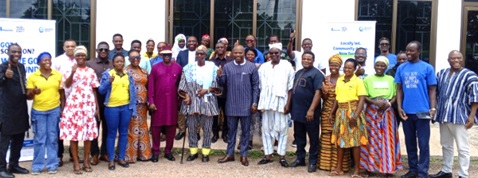
Women-led organisations, community-based groups and local institutions in five districts of the Upper East Region are set to benefit from a €150,000 grant under the newly launched Financing Locally-led Action for Resilient Ecosystems (FLARE) Project to implement climate-resilient water, sanitation and hygiene (WASH) initiatives.
The one-year project, which was launched in Bolgatanga, seeks to finance locally driven solutions that address the growing impacts of climate change on water security, sanitation and livelihoods, while empowering women and marginalised groups to lead climate adaptation efforts.
The project, funded by the Water Justice Fund of WaterAid Netherlands and implemented by WaterAid Ghana, also marked the opening of a call for proposals for eligible community groups, women-led organisations, civil society organisations, entrepreneurs and research institutions.
The FLARE Project will be implemented in the Kassena-Nankana Municipal, Kassena-Nankana West, Bawku West, Bongo and Nabdam districts and is expected to support about 30 community initiatives and directly benefit approximately 14,000 people through locally designed climate-resilient WASH interventions.
Climate-resilient solutions
Speaking at the launch, the Head of Strategy, Policy and Campaigns at WaterAid Ghana, Ibrahim Musah, said climate change had become one of the greatest threats to livelihoods in the Upper East Region, making community-led adaptation more critical than ever.
He said the FLARE Project would finance initiatives that addressed climate adaptation, mitigation, environmental restoration and livelihood improvement while strengthening local ownership.
The Monitoring, Evaluation, Accountability and Learning (MEAL) Officer at WaterAid Ghana, Joseph Mwine, explained that 70 per cent of the funding would support locally led adaptation initiatives, 20 per cent would finance movement-building activities such as advocacy and networking, while 10 per cent would support research and learning to generate evidence for policy influence.
Mr Mwine said all funding under the adaptation category would be allocated to women-led or women co-led initiatives.
He explained that communities would identify their own climate-related challenges, develop proposals and directly implement approved projects with technical support from WaterAid Ghana and local partners.
The Programme Manager for WASH and Climate Resilience at WaterAid Ghana, Richard Ntibrey, said the financing mechanism was designed to place communities at the centre of solving their own climate challenges.
He said communities understood their problems better than anyone else and often had practical solutions, but lacked the financial resources to implement them.
The Programme Lead for WaterAid Netherlands and the Water Justice Fund, Vanita Sureja, said access to water was a fundamental human right and should never depend on wealth, gender or social status.
She said the Water Justice Fund sought to promote water as a justice issue by ensuring that safe water remained affordable and accessible to everyone, particularly poor and marginalised communities.
Access to water
The Upper East Regional Minister, Donatus Akamugri Atanga, described the initiative as a timely intervention that would strengthen community resilience against climate change while improving access to safe water and sanitation.
"Climate resilience has become inseparable from our national development aspirations and our collective human security," he said.
He commended WaterAid Ghana and its partners for prioritising women-led and women co-led initiatives, saying women remained central to household water management and possessed invaluable knowledge for designing effective climate adaptation strategies.
