
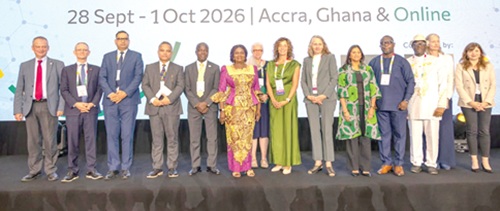
The Vice-President, Professor Naana Jane Opoku-Agyemang, has called for stronger multi-sectoral action and sustained investment to tackle malnutrition across the world.
She stressed the need for coordinated solutions across health, education, agriculture, social protection and the private sector.
Opening the 7th Global Conference of the Micronutrient Forum in Accra yesterday, Prof. Opoku-Agyemang said malnutrition remained one of the most persistent challenges to human development, with consequences extending from childhood into adulthood and pregnancy, placing the health of mothers and children at risk and potentially affecting successive generations.
Prof. Opoku-Agyemang was speaking on the theme, “Nutrition at the Frontiers of a Changing Environment.”
“More than individual interventions, solutions require science, sustained investment, strong public institutions and resilient health systems across countries and sectors,” the Vice-President said.
She pointed out that nutrition was shaped by what families could afford, what children consumed at school, information available to parents and access to health services, and therefore, called for nutrition to be integrated into primary healthcare, maternal and child health, immunisation and community-level services.
“There is, therefore, an opportunity for us to embed nutrition care into prevention, maternal care, child care, immunisation and community-level care,” she said.
Ghanaian efforts
The Vice-President said Ghana was committed to increasing financing for essential nutrition services and improving the tracking of nutrition-related expenditure across government.
Prof. Opoku-Agyemang stated that domestic financing and international cooperation should complement each other, noting that progress would require “national intervention, international cooperation, science and innovation, and many more financial resources made available now to support long-term systems rather than short-term interventions.”
Declaring the 7th Global Conference open, the Vice-President cited the Ghana School Feeding Programme which had reached more than 4.5 million children and commended the Micronutrient Forum, the National Development Planning Commission (NDPC), the Local Organising Committee, sponsors and partners for convening the conference before.
Context
With over 2,200 participants from over 100 countries, and 53 per cent from the conference, is a global public good.
A total of 2,500 participants, 1,500 in person and 1,000 online, are expected to take part in the 7th Global Conference with about 50 per cent of participants from Africa and other low and middle-income countries (LMIC) regions.
The conference reaches the entire nutrition community, sharing the latest evidence on micronutrient health from biology to policy.
The government of Ghana officially requested the Micronutrient Forum to host the conference in Accra with strong regional support from West African regional authorities, ECOWAS and the West African Health Organisation (WAHO), the African Union and the African Development Bank (AfDB).
Examining evidence
The Executive Director of Micronutrient Forum, Saskia Osendarp, said the conference would provide an opportunity to examine evidence on integrating nutrition with other sectors, scaling up cost-effective solutions, using data to inform policies and programmes, and developing new approaches to financing nutrition.
She commended Ghana for her leadership in nutrition and expressed appreciation to the government, the NDPC, the Local Organising Committee and the Ghanaian nutrition community for hosting the conference.
The Acting Regional Director of the Alliance for a Green Revolution in Africa (AGRA), Sunil Dahiya, identified climate change as another major pressure on nutrition.
He said climate shocks could reduce access to nutrient-rich foods and affect the nutritional quality of diets.
Mr Dahiya called for greater investment in climate-resilient and nutritious seeds, improved food storage and processing, efficient regional trade and innovative financing to strengthen nutrition resilience.
Background
The Micronutrient Forum came about because leaders in the field recognised the need and tremendous power of a Global Conference that brought together experts from academia, research institutes, governments, UN and technical agencies, civil society and private sector to address micronutrient malnutrition.
That original mandate as a multi-sectoral convener is all the more urgent due to the need to accelerate progress on malnutrition in the run up to 2030.
The Micronutrient Forum Global Conference established itself as the leading event ensuring evidence is informing programmes and policies for impact at scale.
The forum has more recently successfully organised regional gatherings for sharing evidence and implementation experience among country stakeholders on topics such as the scale-up of antenatal Multiple Micronutrient Supplements (MMS) or the use of data on anaemia to inform comprehensive anaemia policies and programmes.
