
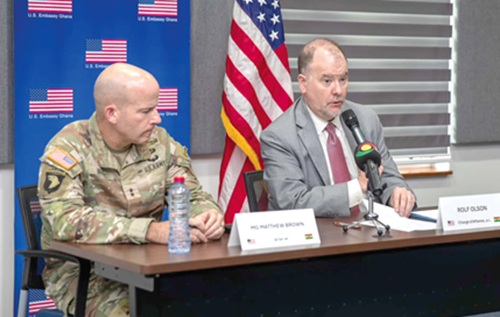
The United States Embassy has clarified that its health assistance to Ghana has not stopped even after the closure of the United States Agency for International Development (USAID), explaining that funding for 2025, 2026 and 2027 was mapped out years in advance.
The Chargé d’Affaires of the US Embassy in Ghana, Rolf Olson, disclosed that the US health funding for Ghana in 2025 was $82 million, which had always been the plan, and that the allocation for 2026 was $53 million.
"That had always been the plan.
That was ongoing in 2025, when the changes with USAID became apparent.
Then the next amount of money in 2026 was $53 million. So again, this was money that was sort of planned over time.
The decisions on those things were to some degree because of the timing which is independent of the discussions around the MoU," he explained.
Media roundtable
Mr Olson gave the clarification at a media roundtable in Accra last Monday, while addressing concerns over the gradual suspension of US health programmes under President Donald Trump’s administration.
He said the pace at which news about USAID unfolded in the early weeks of 2025 created a false impression that all assistance had immediately ceased.
"How quickly that happened in the early days of the Trump administration.
How quickly the news about USAID and how that was unfolding in the initial weeks and months of 2025 gave the impression that the assistance that we were carrying out through USAID was by definition stopping at exactly that time,” the Chargé d’Affaires said.
Mr Olson further explained that USAID did not officially close.
“Our mission here didn't close until July, September range of 2025. So, the USAID was not abruptly closed.
All our assistance did not stop because this was assistance that had been planned for years and mapped out for years," Mr Olson said.
MoU
The Charge d’Affaires indicated that the Memorandum of Understanding (MoU) under discussion with the government of Ghana was an attempt to gradually decrease assistance over a period of years, not to impose a sudden cut-off.
"The issue from our administration is, we believe very much in line with Ghana's vision, which is that it shouldn't be about dependency.
It should be about assistance to try to gradually over time help countries be able to be responsible for their own assistance, for their own countries," he said.
Mr Olson cited the President’s Emergency Plan for AIDS Relief (PEPFAR), created by former President George W. Bush more than 20 years ago, to illustrate US government’s thinking.
He added that, per US Secretary of State Marco Rubio’s vision, the US government after 20 years into PEPFAR needed to be getting to a point where it transitioned away from the part of the funding it was providing in a collaborative way, and in a measured way, over time that would help avoid being abrupt and had to be something that was scaled off slowly.
The American diplomat said the MoU was designed to capture that essence, maintaining funding at the originally planned level in the first year, 2026, and then gradually decreasing over subsequent years.
“And of course, in Ghana's case, the host country does tremendous work in the health sector," he said in commending the government.
Region specific MoU
Mr Olson said the MoU was not identical across countries, as each reflected specific circumstances and prior programming, and were negotiated robustly and in good faith over several months.
“Part of the process of discussing the draft MoU was a period of negotiations, which we engaged in here quite robustly and in good faith on both sides over a period of months to work out those particular details," he said.
He stressed that the door remains open for further discussions with the government to discuss topics of mutual interests.
On the funding amounts, Mr Olson said the figures were not arbitrary but based on existing health assistance programmes, adding that the US had invested significant taxpayer dollars in Ghana's health sector, amounting to $2.2 billion since 2012.
