
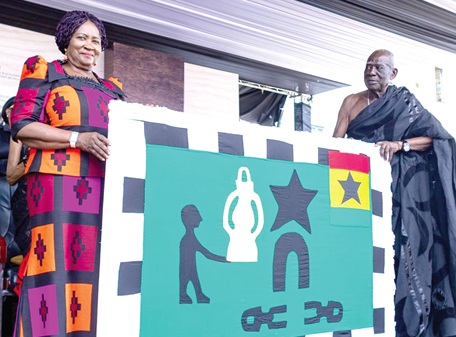
The Vice-President, Professor Naana Jane Opoku-Agyemang, has said that Ghana and the international community must move beyond the recognition of the transatlantic slave trade as the gravest crime against humanity and continue to pursue concrete measures towards reparatory justice.
She said a UN resolution recognising the trafficking of enslaved Africans and the system of racialised chattel enslavement as the gravest crime against humanity should serve as a starting point for education, preservation, restitution and sustained international engagement.
Speaking at a solemn ceremony at the Cape Coast Castle in the Central Region as part of activities marking the 62nd Oguaa Fetu Afahye, the Vice-President said: “Recognition creates responsibility.”
She said the physical evidence of the slave trade was preserved in the nation’s castles, forts, dungeons, courtyards and routes.
They provide a powerful historical record of the inhumane system and, therefore, demand careful preservation and honest interpretation.
There was also the unveiling of a plaque at the Cape Coast Castle and the laying of wreaths in honour of enslaved Ghanaians.
Foundation
Prof. Opoku-Agyemang said although the UN resolution provided a firmer foundation for discussions on reparatory justice, it could not repair centuries of injustice, restore lives or return generations that had been lost.
She said the next phase should focus on education, preservation, restitution, appropriate legal pathways and stronger international engagement.
The Vice-President urged citizens to remember not only the suffering of enslaved Africans, but also their resistance, agency and survival.
She said Africans resisted capture, defended their communities, escaped, organised and fought to preserve their freedom, adding that their descendants have also preserved and transformed their cultures across the diaspora.
Reconnection
The Chairperson of the Oguaa Fetu Afahye Planning Committee, and a former Chairperson of the Electoral Commission, Charlotte Osei, who goes by the stool name Nana Ama Kesse, said the wounds of the slave trade had not ended when the ships left the shores of Africa.
She said the consequences continued to affect families and communities on both sides of the Atlantic, making truth, documentation and reconnection necessary parts of the reparatory process.
Nana Ama Kesse called for the urgent documentation of oral histories from elders before those accounts were lost.
She said the African diaspora should not return to Ghana merely as visitors, but should be encouraged to reconnect with communities and become part of a shared inheritance. “The door named no return must become permanently a door of return,” she added.
Cultural identity
The Omanhen of Oguaa Traditional Area, Osabarimba Kwesi Atta II, cautioned citizens against losing their cultural identity while pursuing reparatory justice.
He urged them to remain vigilant and unite to protect their identity and determine their own future.
Speaking on behalf of the Overlord of the Gonja Traditional Area, Yagbonwura Bii-Kunuto Jewu Soale 1, Chief Dr Abu Sakara said reparations should not be viewed solely in terms of money but as an opportunity to restore dignity and reconnect Africans on the continent with their descendants in the diaspora.
He said the Yagbonwura was prepared to support the offer of citizenship to members of the diaspora by making lands in the Savannah available to those who wished to settle and integrate with local communities.
Recognition
The Canadian High Commissioner to Ghana, Myriam Montrat, said the history of slavery should be remembered honestly, stressing that the people taken from Africa were not born enslaved but were born free, with families, languages, traditions, ambitions and dreams.
She said recognition was not the destination but the beginning of a deeper responsibility, requiring education, preservation of historical sites and archives, and restitution of cultural heritage and investment in communities connected to the history.
The High Commissioner said Cape Coast should become not only a place of remembrance but also a place of learning, dialogue and engagement between Africa, the diaspora and the wider world.
