
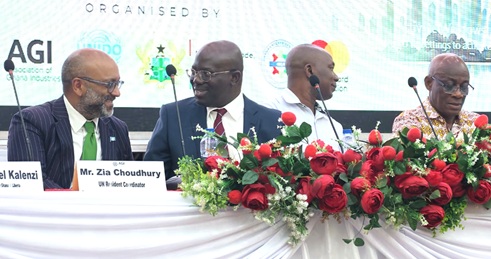
The United Nations (UN) has pledged to support the implementation of the $10 billion New Economy Programme, particularly efforts to accelerate industrialisation, promote value addition and diversify the country's productive base.
The UN Resident Coordinator in Ghana, Zia Choudhury, said the UN, working with the United Nations Industrial Development Organisation (UNIDO), which leads on industrial development, was ready to support the government and industry as the programme moved from policy announcements to implementation.
He said the success of the agenda would depend on strong partnerships among the government, industry, financial institutions, development partners and civil society to mobilise the investment needed to transform the economy.
At the 66th annual general meeting (AGM) of the Association of Ghana Industries (AGI) in Accra last Friday, Mr Choudhury stressed the need for Ghana to move beyond exporting raw materials and focus on processing more of what it produces to create jobs, strengthen productive capacity and build a more competitive and sustainable economy.
"The UN system in Ghana, with UNIDO leading on industrial development, stands ready to support the government and industry as the New Economy programme moves from announcement to implementation.
"We are committed to bringing partners together around national priorities to support the country's industrial transformation," he added.
The AGM
The 66th Annual General Meeting (AGM) was used to mark the 2026 Africa Industrialisation Day.
On the theme, "Financing industrialisation for inclusive and sustainable development," the event focused on moving the economy from macroeconomic stabilisation towards production-led growth through improved access to affordable industrial financing and increased local value addition.
Discussions also centred on leveraging the government's 24-Hour Economy policy and the African Continental Free Trade Area (AfCFTA) framework to expand industrial production, strengthen competitiveness and create sustainable jobs.
Dignitaries included the Economic Advisor to the President and former Minister of Finance, Seth Terkper; Director of Industries at the Ministry of Trade, Agribusiness and Industry, Kofi Addo; President of the Association of Ghana Industries (AGI), Kofi Nsiah-Poku; Resident Representative of the UNIDO to Ghana and Liberia, Dr Emmanuel Kalenzi; Immediate Past President of the Association of Ghana Industries (AGI), Dr Humphrey Kwesi Ayim-Darke; and Chief Executive Officer of the Association of Ghana Industries (AGI), Seth Twum-Akwaboah.
Financing industrialisation
Mr Choudhury said the successful implementation of the New Economy agenda would require increased financing from both the public and private sectors to expand productive capacity and create sustainable jobs.
He called for the mobilisation of domestic and international resources, partnerships and political commitment to accelerate Ghana's industrial transformation and deliver the objectives of the New Economy programme.
Govt committed
For his part, Mr Terkper said the government had committed GH¢30 billion to the New Economy programme in the 2027 Budget as the first phase of a four-year strategy covering 2027 to 2030 to transform the country's economic structure.
He explained that the programme was designed to shift the economy from stabilisation and recovery towards production, value addition, exports and job creation by expanding productive capacity and supporting businesses.
Mr Terkper stressed that Ghana could not achieve sustainable prosperity by continuing to import goods it had the capacity to produce and exporting raw materials without adding value.
Innovative financing
The AGI President stressed the need for a more innovative financing ecosystem involving the government, commercial banks, development finance institutions, pension funds, private equity investors and international development partners to support industrial growth.
He said particular attention should be given to affordable long-term financing, targeted support for strategic industries, credit guarantees and working capital for small and medium-sized enterprises (SMEs), as well as investment in technology, innovation and renewable energy.
