
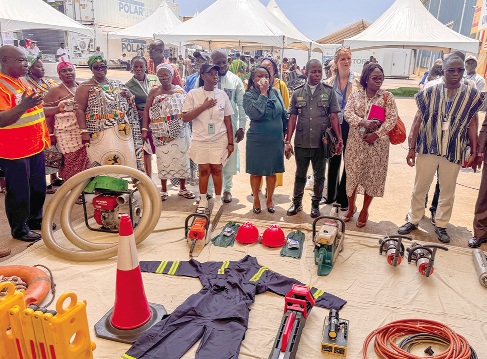
Households and communities must prioritise disaster prevention and preparedness to protect lives, property and livelihoods.
The Director of the United Nations Climate Change Adaptation and Disaster Risk Reduction Department, Charlotte Norman, said a shift from responding to disasters after they occurred to investing in prevention and preparedness was necessary to reduce their impact.
“Disaster risk reduction requires collective efforts by households, communities, government agencies, development partners and the private sector to build a resilient nation,” she said.
She made the call at a symposium and exhibition organised by the United Nations Humanitarian Response Depot (UNHRD) in Accra today (October 13) to mark this year’s International Day for Disaster Risk Reduction (IDDRR).
The event was held on the theme, “Resilience Starts at Home”, and brought together officials of the National Disaster Management Organisation (NADMO), the Ghana Navy, the Ghana National Fire Service, the Ghana Meteorological Agency, traditional leaders, development partners, exhibitors and the media.
Disaster management
Ms Norman said disasters were often worsened by poor planning, environmental degradation and inadequate preparedness, stressing that decisions on housing, environmental protection and emergency response had direct implications for the safety of individuals, families and communities.
She urged development partners, the private sector and other stakeholders to share knowledge and innovative solutions to strengthen disaster prevention, noting that no single institution could effectively address disaster risks without collaboration.
Building resilience
The Deputy Director-General of NADMO in charge of Technical, Ahmed Rufai Aggudey, said building resilience began with individuals and families but required sustained institutional investment and a collective commitment to protecting lives, livelihoods and property.
He said the theme was a reminder that households had a responsibility to prepare for disasters, while institutions had to invest in systems to strengthen prevention and response.
Mr Aggudey cited the Sendai Framework for Disaster Risk Reduction 2015-2030, which emphasises understanding disaster risks, strengthening risk governance, investing in resilience and enhancing preparedness for effective response and recovery.
He said disaster management efforts should go beyond responding to emergencies to prioritise prevention, preparedness and proactive risk management.
The Queen Mother of Katamanso Akotiampong, Naa Kai Shika Ayoo, urged households to keep their surroundings clean, avoid building on watercourses, dispose of waste properly and take precautions against fire outbreaks and flooding.
She said educating children on safety measures would help protect future generations, adding that building a disaster-resilient country required responsible actions by individuals and communities rather than relying solely on government interventions.
A Resilience Specialist at the FAO Regional Office for Africa, Dominique Reumkens, said households that understood the risks they faced, prepared emergency plans and acted promptly were better positioned to reduce disaster-related deaths and losses.
On the role of the UNHRD in Africa, he said the facility demonstrated the importance of international cooperation in humanitarian response.
He said the government had provided land and supported the facility’s operational costs, with government backing dating back to 2007.
Mr Reumkens expressed appreciation to the government, NADMO and the Emergency Working Group on Emergencies for their continued support for the facility’s operations.
