
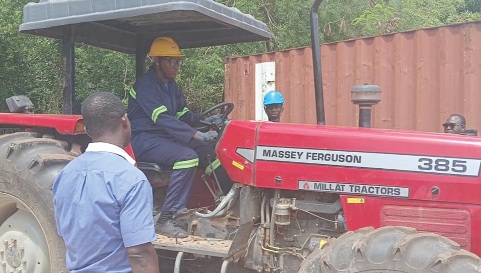
The University of Cape Coast (UCC) has equipped 15 agricultural engineering students with practical tractor-operation skills and Category E driver's licences.
The intervention was to strengthen their professional readiness and promote agricultural mechanisation.
The training, organised through a collaboration between the university and the Driver and Vehicle Licensing Authority (DVLA), provided the students with hands-on experience in operating tractors and carrying out basic farm operations, complementing the theoretical knowledge acquired in the classroom.
The Coordinator of the AG Carson Technology Centre, Dr Josiah Tachie-Menson, who represented the Dean of the School of Agriculture, said the training marked the culmination of efforts to equip agricultural engineering students with practical skills relevant to the country's agricultural needs.
He said the initiative would be extended to students in other agriculture-related programmes, including BSc Agriculture and Agribusiness, to broaden access to practical mechanisation training.
Dr Tachie-Menson said traditional farming methods alone could not meet the food needs of Ghana's growing population, making the adoption of mechanised agriculture essential.
He expressed appreciation to the institutional partners and stakeholders who supported the initiative, including the DVLA and the Wealthy Programme, and encouraged the students to put their newly acquired skills into practice.
The Vice-Dean of the School of Sustainable Engineering, Professor Ernest Ekow Abano, described the initiative as a significant development in engineering education, saying it was the first time, to his knowledge, that agricultural engineering students in the country had received tractor-operation training and Category E licences before completing their studies.
He said the programme was designed to address the gap between theoretical instruction and practical competence, adding that students were trained in tractor operation, basic maintenance and farm activities such as ploughing, harrowing and ridging.
The Head of the Department of Agricultural and Mechanical Engineering, Prof. Francis Kumi, stated that the training would give the students an advantage because it enabled them to connect classroom theories with the practical demands of the agricultural sector.
He said the involvement of the DVLA was particularly important because it ensured that the students not only acquired the skills to operate tractors but also obtained the required licences to do so legally.
He urged the students to apply their knowledge responsibly and use the skills to support sustainable agricultural production.
A Registered Engineer at the Central Regional Directorate of Food and Agriculture, Boffah Owusu Akyeaw, said mechanisation had become increasingly important because agricultural lands were shrinking, requiring farmers to make more productive use of the available land.
An official of DVLA, Emmanuel Frimpong Opoku, said the authority's involvement was to ensure that the students completed the necessary processes to obtain Category E licences, which covered the operation of specified heavy-duty equipment, including agricultural tractors.
