
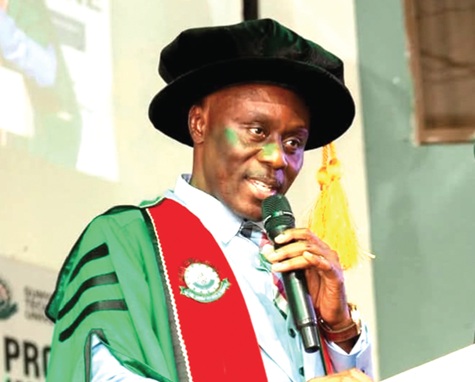
The government has been urged to integrate circular construction into national policies and establish standards for the safe use of recycled materials in the construction industry.
The industry has also been encouraged to adopt building materials produced from waste and locally available resources to minimise environmental degradation and reduce pressure on natural resources.
The Vice-Chancellor of the Sunyani Technical University (STU), Professor Kwadwo Adinkrah-Appiah, made the call when he delivered his professorial inaugural lecture on the theme:
“Valorisation of Waste to Bridge Circularity and Civil Engineering Construction in the Era of Sustainability”.
He said the industry needed to move from extracting, using and disposing of raw materials to a circular system based on reuse, recovery and recycling.
Prof. Adinkrah-Appiah observed that about 90 per cent of walls in Ghanaian buildings were made of sandcrete blocks, placing pressure on natural sand deposits.
Research findings
Sharing his team's research findings, he said studies had demonstrated the potential of local materials and industrial waste to produce alternative building materials.
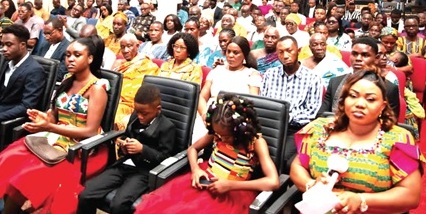
A section of the participants
A study on salancrete blocks, made from sand, laterite and cement, recorded an average compressive strength of 5.76 Newtons per square millimetre (N/mm²), compared with 3.78 N/mm² for conventional sandcrete blocks and 3.09 N/mm² for landcrete blocks.
The results highlighted laterite's potential for producing stronger building materials.
The research, which began in 2009, led to a production unit at the STU's Building Technology Department to manufacture salancrete and Hydraform interlocking blocks.
It received the Ghana Institution of Engineers' Most Innovative Research of the Year Award in 2016.
Another study examined sawdust ash as a partial cement replacement in laterite interlocking blocks.
Replacing 20 per cent of the cement with sawdust ash produced blocks with a compressive strength of 6.32 N/mm² after 28 days, meeting the minimum requirement for load-bearing masonry under the Ghana Building Code.
Prof. Adinkrah-Appiah said the finding showed the potential of industrial waste to reduce cement use.
In a 2026 study published in Discover Civil Engineering, the team investigated palm kernel shells as coarse aggregates in reinforced concrete deep beams.
Beams without shear reinforcement recorded ductility ratios 60 per cent higher than normal-weight concrete beams; those with vertical shear reinforcement recorded ratios 30 per cent higher.
The findings indicated the potential of palm kernel shells to improve beam ductility and provide another use for agricultural waste.
Barriers to adoption
Prof. Adinkrah-Appiah identified weak uptake of innovations, inadequate regulatory frameworks, limited markets for recycled materials and insufficient funding as barriers to sustainable construction.
He said information on recycled materials' strength, durability and long-term performance was limited, as was professional training in circular construction.
He urged construction companies to partner universities and research institutions to adopt local innovations and called on universities to strengthen research and include circular construction in their training programmes.
He said bridging the gap between academic research and industrial application would create markets for locally developed materials and reduce dependence on virgin resources.
The STU vice-chancellor concluded that construction, agricultural and industrial waste could be converted into useful building materials, urging stakeholders to embrace locally developed and recycled materials in homes and public infrastructure.
Ghana, he said, could shift from extraction, use and disposal to circular construction based on reuse, recycling, recovery and durability.
Writer's email:
