
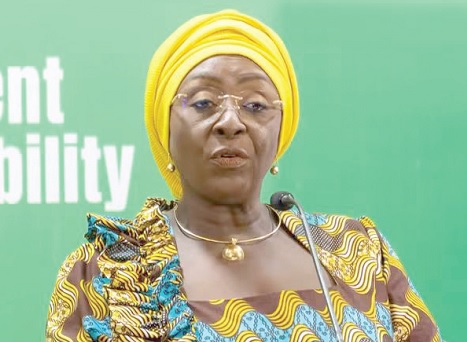
The tourism sector generated $4.34 billion in revenue last year, the Minister of Tourism, Culture and Creative Arts, Abla Dzifa Gomashie, has disclosed.
She attributed the performance to digitisation, the introduction of new heritage products and an aggressive drive to reposition the industry beyond its traditional December peak.
The tourism minister made this known in Accra yesterday at the Jubilee House when she took her turn at the government’s Accountability Series, where she rendered a comprehensive account of the ministry’s stewardship since she assumed office.
Presenting the figures, Ms Gomashie said international tourist arrivals shot up to 1,306,962 (up by 1.3 million) in 2025, rising from 1,288,804 (1.28 million) recorded the previous year.
Domestic tourism visits also saw a seven per cent increase, moving from 1.68 million to 1.79 million.
The 10 most-visited attractions, spearheaded by the Kwame Nkrumah Memorial Park and Kakum National Park, collectively attracted 1,377,588 visitors, representing approximately 77 per cent of all domestic site visits nationwide.
Licensed tourism enterprises expanded from 6,702 to 7,109, representing a 6.1 per cent growth, which the minister indicated was largely driven by 18.6 per cent surge in travel trade businesses, including tour operators and travel agencies.
Highlife on world stage
Ms Gomashie described the inscription of Highlife music and dance onto UNESCO’s Representative List of the Intangible Cultural Heritage of Humanity as one of the ministry’s proudest accomplishments for the year.
The feat, she said, positioned the genre alongside kente as a heritage "Ghana gave to the world."
Ms Gomashie stated that the recognition would stimulate cultural tourism, create international opportunities for Ghanaian musicians, and safeguard the art form for posterity.
The tourism minister further announced the rollout of the Black Star Experience, a year-round national programme that integrates festivals, film, fashion, food, music, and heritage under a unified banner, designed to distribute tourism activity evenly across the calendar rather than concentrating it solely in December.
Digital platforms, 'Accra by Night'
Ms Gomashie said the ministry transitioned the sector into the digital economy in 2025 through the Ghana Tourism Marketplace and the Ghana Tourism Investment Platform.
Those platforms, she explained, enabled tourists to book verified experiences online while providing investors with access to data-backed opportunities.
She stated that the "Accra by Night" tour, introduced as a structured night-time tourism product, accounted for approximately 93 per cent of total platform revenue during the December 2025 festive season, which she cited as validation of the government’s 24-Hour Economy agenda.
Infrastructure, film fund and diplomacy
Touching on infrastructure, the minister enumerated the reopening of the Nationalism Park following the resolution of power challenges, the completion of the Tano Boase Sacred Grove project, and enhanced management at heritage sites, including the Anomabu Garden of Return.
On the creative arts front, Ms Gomashie indicated that the National Film Authority was targeting an increase in the film sector’s contribution to total productivity within the economy — Gross Domestic Product (GDP) — by at least one per cent, up from the current 0.2 per cent.
She confirmed that the government had allocated GH¢20 million in the 2026 Budget for a Film Development Fund, with its legislative instrument currently pending before the Office of the Attorney-General awaiting transmission to Parliament.
The Creative Arts Fund has also been allocated GH¢20 million seed fund.
Regarding the National Theatre of Ghana, the tourism minister disclosed that a 2026–2030 Strategic Plan had been developed, patronage had risen by 15 per cent as of July 2026, following the refurbishment of its facilities, and that the Chinese government was providing support for a major renovation exercise after a technical assessment was conducted in December 2025.
Ms Gomashie further revealed that South Korea was funding a $4.5 million, five-year project to protect Ghana’s forts and castles from the adverse effects of climate change, covering six heritage sites in the Greater Accra Region, with an official launch scheduled for August 26.
She also cited a GH¢1.7 million agreement with Denmark for restoration works at Christianborg Castle, as well as the €2.5 million European Union-funded Sankofa II project, which is supporting heritage conservation and the creative industries over a 36-month period.
Bureau of Ghana Languages
On language development, Ms Gomashie said the Bureau of Ghana Languages had increased the number of standardised Ghanaian languages from 11 to 16, with three more orthographies expected to be completed before the end of the year, fulfilling a manifesto commitment to standardise the country's indigenous languages.
