
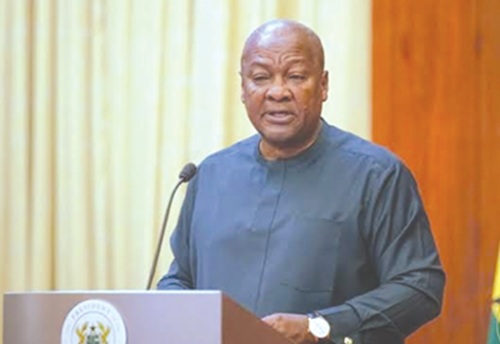
When John Dramani Mahama assumed office on January 7, 2025, he accomplished a historic feat: the first former president in Ghana’s Fourth Republic to successfully reclaim the executive office after being voted out.
Globally, Mahama’s return was hailed as a triumph of democratic resilience.
Shortly after his inauguration, he was elected the Second Vice Chairperson of the African Union.
With soaring international prestige, he swiftly positioned Ghana as an essential multilateral interlocutor, speaking with great fluency to the International Monetary Fund (IMF), Western capitals, and regional bodies.
Yet, as Ghana enters the second half of his four-year presidency, there is a contrast between President Mahama’s extensive foreign profile and his government’s domestic performance.
The structural crises inherited from the Akufo-Addo administration – in tandem with the rigid political economy of an ongoing IMF programme – severely constrain the government’s domestic room for manoeuvre.
So, while President Mahama operates with cosmopolitan finesse abroad, at home he is engaged in a difficult battle against economic stagnation, austerity, and a delicate religious-political environment.
Cosmopolitan diplomat and would be reformer
Mahama’s foreign policy is anchored in what analysts call ‘liberal internationalism’, a philosophy that prioritises institutional engagement and regional cooperation.
His elevated standing within the African Union allows him to project Ghana’s soft power.
To international observers, he presents a model of decisive, technocratic governance – a reputation he sought to solidify domestically by achieving a contentious 23 per cent reduction in government ministries from 30 down to 23.
To the international financial community, significant ministerial consolidation was seen as an exemplary commitment to fiscal discipline and cost-efficient governance, directly aligning with the stringent conditionalities of Ghana’s active $3 billion IMF loan.
Domestically, however, this institutional restructuring has yielded only negligible relief for ordinary citizens.
For the average voter, macro-level ministerial downsizing does not offset the immediate structural hardships of inflation, high utility tariffs, and a severely restricted public sector job market.
Austerity trap and domestic friction
The central paradox of Mahama’s second coming lies in the friction between international economic compliance and domestic expectations.
Having won the 2024 presidential election largely on the back of widespread public anger over an unprecedented economic crisis, debt default, and rampant inflation under his predecessor, Nana Akufo-Addo, Mahama inherited a severely damaged economy.
To maintain international financial credibility and secure vital tranches of IMF funding, the new government had no choice but to enforce strict fiscal consolidation.
Now, his government’s domestic record is being aggressively defined by the very austerity he once campaigned against.
The state’s limited fiscal space has obstructed domestic infrastructure development, squeezed small businesses, and led to mounting friction with trade unions and civil society organisations.
Sophisticated diplomacy that secures praise in Moscow, Washington or Addis Ababa fails to resonate with a domestic populace suffering from a prolonged cost-of-living crisis.
Navigating the faith-based fault lines
Beyond the economic sphere, Mahama faces a complex domestic arena where politics and religion are deeply intertwined.
In a society where faith-based organisations wield massive electoral leverage, the president has to navigate highly polarising cultural and religious policy dilemmas.
A primary example is the long-running controversy surrounding the National Cathedral.
Seeking to project fiscal prudence and break from the past, Mahama announced that public funds would no longer be utilised to finance the National Cathedral, underlining that it was a personal pledge of his predecessor not official government policy.
While secular advocates and economic reformers strongly applauded the move to shift remaining costs to private partners, the decision sparked quiet resentment among certain powerful Christian factions who viewed the project as a monumental national spiritual symbol.
Concurrently, President Mahama has to manage intense domestic pressure regarding conservative social legislation, notably the highly controversial anti-gay bill.
On this front, the president is trapped in a classic global-local vice: signing the bill risks triggering immediate sanctions, capital flight, and severe condemnation from international human rights partners; vetoing it risks total alienation from conservative religious leaders who wield massive moral authority in a highly religious country.
Conclusion: The lame-duck dilemma
Mahama’s political calculation is further complicated by his explicit declaration to serve only a single four-year term.
This ‘one-and-done’ stance is constitutionally appropriate and simultaneously frees him from future electoral anxieties.
Theoretically, this could enable the president energetically to pursue necessary, yet painful, economic structural reforms.
But there is a dangerous domestic side-effect: without a 2028 presidential bid, President Mahama is now a ‘lame duck’ within his own party, the NDC.
Ambitious party elites jockey for position in the looming post-Mahama era, and domestic policy implementation becomes secondary to internal party factionalism.
President Mahama is a much-respected statesman across Africa and the wider international scene.
Yet his government’s record underlines a sobering truth of contemporary governance: international prestige is no substitute for domestic esteem.
So long as global fiscal compliance overshadows tangible local economic prosperity, Mahama’s second coming will be seen as external triumph and domestic disappointment.
The writer is Emeritus Professor of Politics, London Metropolitan University, UK
